Table of content:


3PL companies are growing exponentially in India because of the increase in the number of ecommerce companies. Research says the 3PL logistics market will reach USD 61.02 billion by 2030.
Ecommerce 3PL handles everything from warehousing and inventory management to order delivery and returns. When an e-commerce business outsources its supply chain and logistics activities, it reduces costs and focuses on its core operations, such as sales and marketing.
What is 3PL in Ecommerce?
3PL in e-commerce refers to outsourcing logistics and supply chain activities to a third-party logistics company. The 3PL Company handles picking, packaging, and shipping the ordered product to the customer.
For example, you run an online clothing store. You can store your products at home or in your store room during the initial stage of your business. You can pack it by yourself and deliver it to your customer through shipping companies. But when you get more orders, managing everything becomes like climbing a mountain. You don't have enough space to store the clothes. Again, late shipping can have a negative impact on your customer. There comes the need for an ecommerce 3PL service. The third-party logistics Company in India stores the products in its warehouse. It picks, packages, and ships the product to the customer's doorstep.
How Does It Differ From 1PL And 2PL?
| Features | 1PL | 2PL | 3PL |
| Definition | The business handles its own logistics. | Here, the business hires a transportation provider. | Here, the business outsources various supply chain activities to the third-party logistics provider. |
| Role | The manufacturer will deliver the product directly to the customer | The transporter will deliver the products of the company to the customer. | The third-party logistics provider stores products. It even does picking, packaging, and shipping of the products. |
Services Offer By 3PLs For Ecommerce
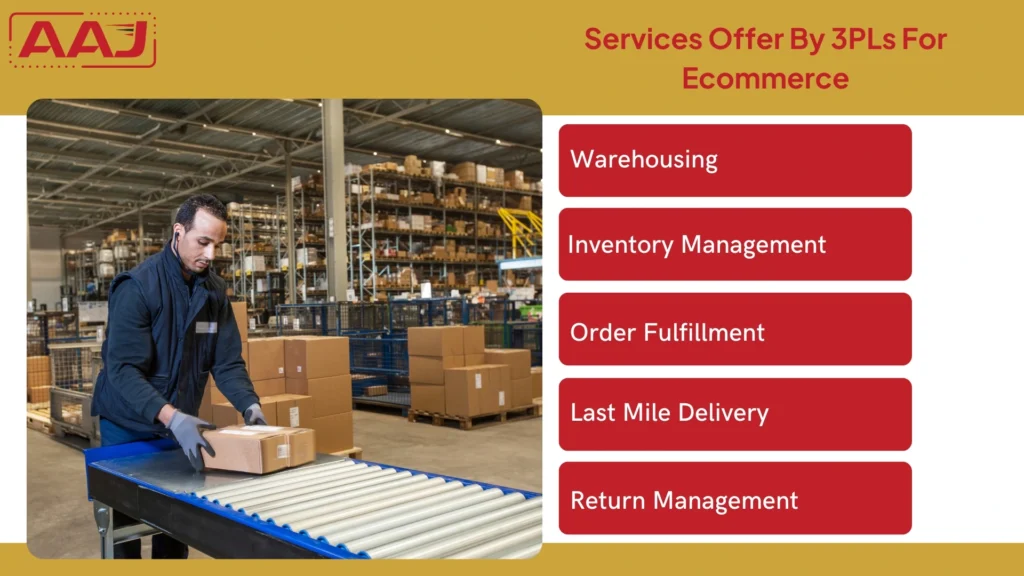
3PL for e-commerce provides various services, which are listed below.
1. Warehousing
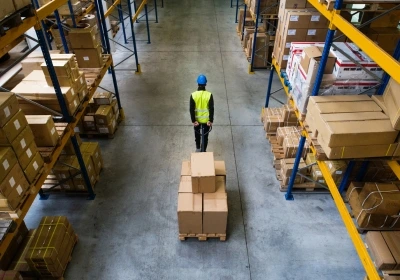
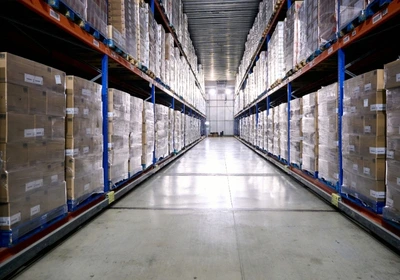
The staff of the third-party logistics company receives the products from a business. They inspect the products thoroughly and store them on shelves, bins, or pallets. Some warehouses have temperature-controlled storage systems, where perishables or pharmaceutical products are stored to maintain quality.
2. Inventory Management
Most 3PL companies have advanced technology for managing inventories, such as an inventory management system. The software provides real-time inventory updates and avoids overstocking and out-of-stock problems.
3. Order Fulfillment
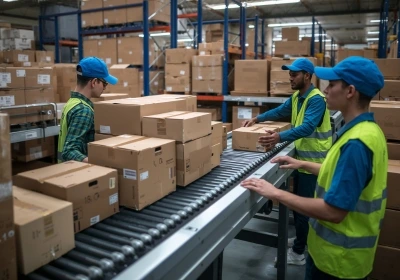
When a customer orders products from the e-commerce marketplaces, the details are automatically sent to the ecommerce 3PL Company's system. The staff picks up the ordered product from the shelf and moves to the packaging station. The picked product is appropriately packaged to prevent damage during transit. It is then handed to the shipper.
4. Shipping And Last Mile Delivery
3PL companies handle the shipping process by working with multiple courier companies. They select the best courier based on speed, price, and region.
Last-mile delivery is the final step of the supply chain process. It involves transporting the package from the warehouse to the customer's doorstep. Most reputable 3PL companies in India utilize route optimization software to select the most efficient route for order delivery.
5. Return Management
Sometimes the customer doesn't like the ordered product and places a return request on the ecommerce platform. The details are sent to the 3PL warehouse automatically. The staff of the Company pick up the product from the customer's doorstep and then bring it back to the warehouse. The staff inspects the product thoroughly, and then the decision is either to refurbish, recycle, remanufacture, or discard it.
Why Ecommerce Businesses Need 3PL Today?
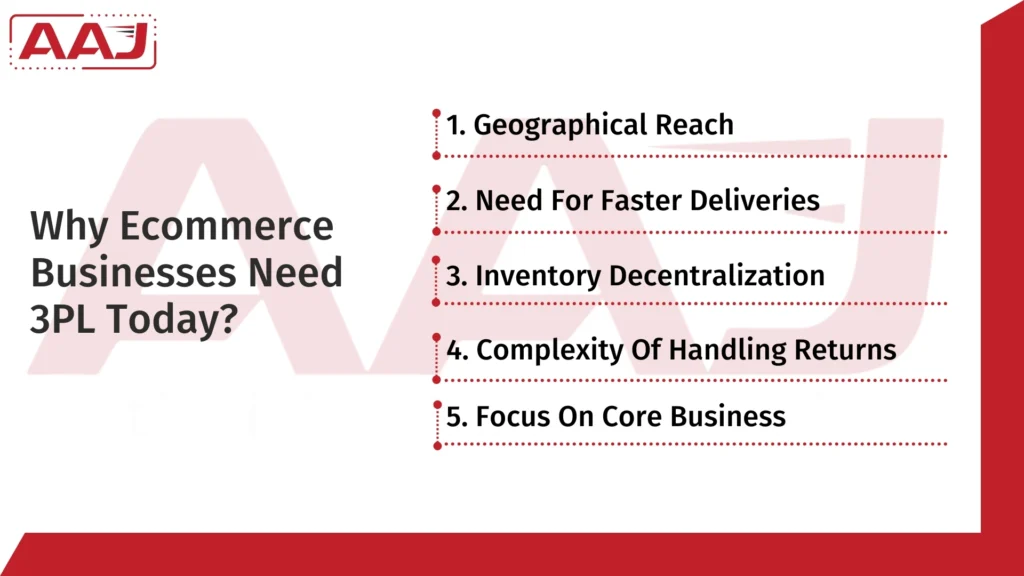
Many e-commerce businesses need 3PL Today for the following reasons.
1. Surge In Order Volumes And Geographical Reach
Today, an increasing number of customers prefer to purchase products online. Managing high-order and delivering high-order volumes across broad geographies can be challenging for in-house businesses. A 3PL ecommerce company has warehouses for storing products. It manages the order efficiently and gives it to the customer on time.
2. Need For Faster Deliveries
Today, most customers expect their ordered product to be delivered on the same day or the next day. A 3PL ecommerce company fulfills the orders on time and enhances customer satisfaction.
3. Inventory Decentralization Across Regions
Businesses can fulfill orders quickly if they place the inventory closer to the customer's location. Most of the reputed ecommerce 3PL companies have warehouses in various regions of India. This keeps their stock closer to the customer to reduce logistics costs. It also allows a 3rd party logistics Company to deliver products quickly to customers.
4. Complexity Of Handling Returns And Exchanges
Sometimes customers request a return because of a defective product or other reasons. Managing returns can be costly and complex for an in-house business. A 3PL ecommerce company efficiently processes returns, restocks items, and manages refunds.
5. Focus On Core Business
When a business outsources its supply chain and logistics activities, it can focus on the core aspects of the industry, such as developing new products, exploring new markets, sales, and more.
Common Challenges & How 3PLs Solve Them
1. Inconsistent Order Accuracy
Manually picking the ordered product and packaging it can lead to errors. A business can deliver the wrong product to customers, which creates a negative impression.
Reputed 3PL companies use barcode and scan-based warehousing operations for picking the ordered product from the shelf of the warehouses. It reduces manual errors and ensures the delivery of the right products to the customer.
2. Delivery Delays In Tier 2/3 Cities
Delivering products to non-urban or remote areas can be challenging for an in-house business due to poor road connectivity.
However, ecommerce 3PL companies have multiple warehouses in India. They maintain inventories closer to customers and thus deliver products on time, even to remote and non-metro cities.
How to Choose the Right 3PL Partner?
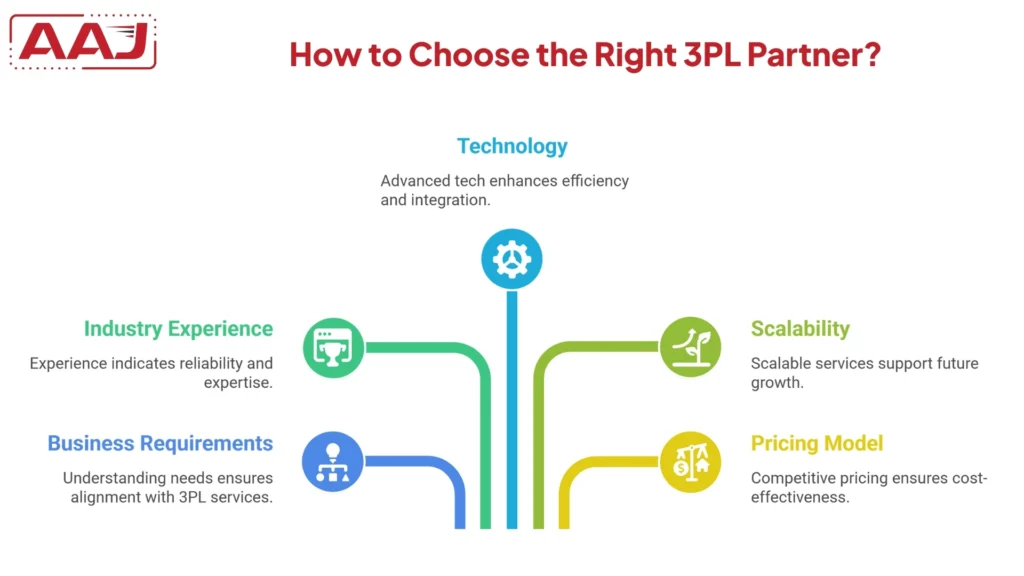
When choosing a good 3PL for e-commerce, consider various factors.
1. Understand Your Business Requirements
You should first assess your business requirements, i.e, whether you need domestic or international delivery. Additionally, determine whether you need cold storage to store temperature-sensitive products.
Accessing your basic needs can help you find a third-party logistics provider that meets your requirements.
2. Evaluate Industry Experience
You need to evaluate the experience and expertise of the 3PL company. Select a company with positive ratings and reviews. It's best if it has experience handling your product categories, such as fashion and perishables.
3. Check technology
Select an ecommerce 3PL company that utilizes modern technology, including a warehouse management system, data analytics, and an inventory management system. The technology helps deliver ordered products faster. It aids in solving problems like overstocking and out-of-stock issues.
4. Scalability
A 3PL company for e-commerce needs to offer scalable solutions, which means it can accommodate an increasing number of products in its warehouse as your business expands.
5. Compare Pricing Model
Compare fulfillment fees, storage charges, and shipping costs of various 3PL providers. Choose the one that provides the best services at affordable fees.
Final Words
Today, customers expect their ordered product to be received efficiently and quickly. Managing storage and delivering products to customers' doorsteps can be challenging for an in-house business. There comes the importance of an ecommerce 3PL company.
They have a warehouse for storing products properly, usually under 24/7 surveillance. Therefore, an in-house team does not have to spend money on building warehouses or managing inventories when it outsources supply chain and logistics activities to an ecommerce 3PL partner. It delivers products to customers faster, enhancing brand reputation in the market.