

Table of content:
- What Is Inventory Accuracy?
- Why Inventory Accuracy In A Warehouse Breaks?
- What Breaks When Inventory Accuracy Breaks Down?
- How To Improve Inventory Accuracy?
- What Is A Good Inventory Accuracy Benchmark?
- When Inventory Accuracy Problems Indicate A Bigger Structural Issue?
- Inventory Accuracy Versus Inventory Visibility
- Conclusion


Inventory accuracy is one of the most important performance indicators in warehouse operations. It measures how close the system records matches with the stock available in the warehouse. The business can fulfill customer orders quickly and make wiser decisions when the inventory accuracy is high. Businesses can face overstocking or understocking issues and operational chaos when the inventory accuracy is low.
What Is Inventory Accuracy?
Inventory accuracy measures the precision of stock counting in a business. It measures how closely the recorded inventory in the advanced software, i.e., warehouse management system, matches the physical stock count. Inventory accuracy is always expressed as a percentage. In the ideal world, the inventory records system should exactly match the physical count. But in reality, it is not possible because of theft, deadstock, or simple data entry mistakes. A high inventory accuracy ensures that stock records are correct and prevents financial loss, overstocking, and understocking issues. But maintaining such high accuracy requires proper staff training, regular inventory checks, and the use of advanced tools like barcode scanning and automation.
Inventory Accuracy Formula
1. Unit Based Formula
It compares the number of physical inventories stored in the warehouse to that recorded in the warehouse management system.
Unit based formula = Physical units * 100 / Recorded Units
Let's discuss with an example
When the warehouse staff counted the inventory, it was 950 units. The system has recorded 1000 units.
So inventory accuracy in this case will be 950*100/1000 = 95%
2.Value Based Inventory Accuracy
It compares the monetary value of physical countries to that recorded in the system.
Value based formula = Actual inventory value * 100 / Recorded inventory value
Let's discuss with an example.
Recorded inventory value in a warehouse = Rs 5,00,000
Actual inventory value = Rs 4,80,000
So accuracy = 4,80,000 * 100 / 5,00,000 = 96%
Why Inventory Accuracy In A Warehouse Breaks?
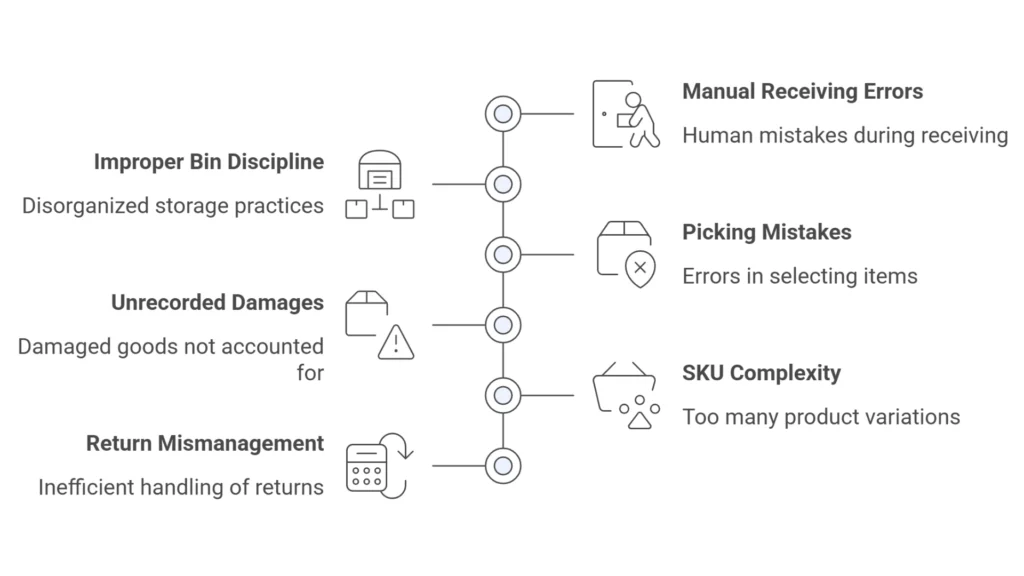
Inventory accuracy in a warehouse can be compromised for various reasons. They are in the list below.
1. Manual Receiving Errors
The warehouse staff usually count the products that arrive from the seller or manufacturer and enter them in the system. But if the staff makes mistakes while counting products or entering quantities, the inventory becomes inaccurate.
2. Improper Bin Discipline
Improper bin discipline occurs when the warehouse does not store items in their proper locations. Sometimes the staff place the product in the wrong bin and do not update the system. Consequently, the inventory appears to be missing in the warehouse management system, causing confusion.
Improper bin discipline usually occurs because of overcrowded racks or poor labelling.
3. Picking Mistakes
Picking mistakes usually occur when the warehouse staff picks up the wrong products or quantities while doing the order fulfillment process. This reduces the inventory accuracy of the warehouse. Picking mistakes usually occur because of improper labelling, a lack of barcode scanning, or the presence of two similar-looking products on the shelf.
4. Unrecorded Damages
The product can get damaged during unloading, storage, or handling. If the warehouse staff discards them but does not update the system, it shows false stock availability in the warehouse. This can even cause out-of-stock issues and dissatisfy customers.
5. SKU Complexity
SKU complexity happens when the warehouse has to manage a lot of similar-looking products. The same product can come in different colours, sizes, or packaging types. The warehouse staff can get confused and count incorrectly or keep them in the wrong bin.
So, SKU complexity reduces a business's inventory accuracy.
6. Return Mismanagement
Returned items are one of the major causes of inventory discrepancies. The warehouse staff needs to properly inspect returned products and decide whether to restock, refurbish, or recycle them. If staff do not inspect the product or do not enter it into the system after inspection, it reduces inventory accuracy.
What Breaks When Inventory Accuracy Breaks Down?
1. Customer Facing Failures
The stock may appear in the system, but in actuality, it may not be there in the warehouse when the inventory accuracy breaks down. This can lead to order cancellations and shipping delays. Customers may receive the wrong products because of picking errors. These dissatisfied customers do not want to purchase products from that particular brand.
2. Increases Operational Strain
The reduction of inventory accuracy even increases the operational strain of the business. The warehouse staff spends extra time searching for the missing products. The business even needs to do frequent cycle counts and emergency audits, and this increases the workload of the staff. Inaccurate data can even lead to poor forecast demand. The staff may rush for replenishment or purchase products unnecessarily.
3. Financial Leakage
Businesses can face issues such as overstocking and understocking when inventory accuracy is low. Overstocking can increase storage costs of the business, while understocking can lead to lost sales opportunities. Financial reports even become unreliable.
How To Improve Inventory Accuracy?
1. Standardise Receiving & Puraway Discipline
The process of inventory accuracy should start from the receiving dock. The warehouse staff must carefully check their quantities and quality, ensuring they are as per the purchasing order. The staff should then do scanning and update the system accurately.
Putaway discipline plays a crucial role in inventory accuracy. The staff needs to keep the products in the correct bin location. Nowadays, most warehouses use advanced software like warehouse management systems to optimize the warehouse facility layout. The system assigns a storage location for products. The business keeps the products assigned exactly as the system does to avoid confusion and speed up order fulfillment.
2. Implement Cycle Counting Strategy
The warehouse staff needs to use the ABC inventory method to improve inventory accuracy.
The ABC method prioritises the inventory based on its value in the market.
Class A
The warehouse should classify products in Class A, which are fast-moving. These products are only 10 to 20 percent of the total inventory, but they contribute 70 to 80 percent of the total revenue.
The warehouse staff needs to count them regularly, e.g., weekly or biweekly, to improve inventory accuracy.
Class B
Class B products are not as valuable as class A products. However, they still require monitoring.
They account for 20 to 30% of total inventory and contribute 15 to 25 percent of total revenue.
The warehouse team can count class B products monthly to improve inventory accuracy.
Class C
Class C products are slow-moving products. They don't require much monitoring. Class C products account for only 5-10% of total revenue.
The warehouse can count them over 6 months to improve inventory accuracy.
3. Reduce Human Touchpoints In Picking
The warehouse staff should avoid handling products by hand whenever possible. Manual activities like reading a label, counting products, or writing quantities have a chance of errors.
The staff can use barcode scanning methods to enhance inventory accuracy. Here, the warehouse staff needs to scan the product at every movement within the warehouse, i.e., during storage, picking, packaging, and shipping. The system automatically updates its quantity, location, and movement, and reduces errors.
RFID systems use wireless signals for scanning products in the warehouse. The warehouse can scan multiple products at a time by remaining a few feet away. But RFID systems have a few limitations, such as they cannot scan products that are damaged. The staff needs to check them manually. Again, RFID systems do not work effectively for metals and liquids.
What Is A Good Inventory Accuracy Benchmark?
A good inventory accuracy benchmark depends on factors such as industry type, product type, and operational complexity.
But most of the warehouses usually aim for 95 to 98% accuracy.
Retail Industry
Typical benchmark - 95 to 98%
Retail industries deal with a lot of order volumes. So theft and product damage are quite common here.
E-commerce and Fulfillment Centers
Typical benchmark - 98 to 99.5%
E-commerce and fulfillment centers depend heavily on real-time inventory visibility. A minor inaccuracy can delay the order fulfillment process.
Pharmaceutical Industry
Typical benchmark - 99.5 to 100%
Pharmaceutical companies need perfect inventory accuracy because of regulatory compliance and patient safety.
When Inventory Accuracy Problems Indicate A Bigger Structural Issue?
- SKU Explosion: When a business keeps adding more products to the warehouse, then storing, managing, and tracking them can become quite complex.
- Multilocation Sync Failure: Poor system synchronisation can cause inventory accuracy issues when a business operates in multiple warehouses, dark stores, and retail outlets.
- Manual Legacy Systems: Accuracy problems can occur when the warehouse still depends on spreadsheets or outdated software.
- Scaling Issues: Sometimes the warehouse layout, staffing model, and technology are not designed for higher-order volumes, which is a major factor in inventory accuracy.
Inventory Accuracy Versus Inventory Visibility
Inventory accuracy says that the system records should exactly match the physical stock in the warehouse and Inventory visibility means tracking inventories in real time to improve supply chain and logistics efficiency.
Conclusion
Inventory accuracy means the system records should match exactly with the stock present in the warehouse. But theft or data entry errors can be a major problem for reducing inventory accuracy. It causes overstocking or understocking and delays order fulfillment. It even dissatisfied customers, and they may purchase from the same brand. Warehouses should implement advanced technologies such as WMS and barcode scanning to improve inventory accuracy.