
Table of content:
- What Is Dropshipping Fulfillment?
- How Dropshipping Fulfillment Works?
- Benefits Of Dropshipping Fulfillment For Retailers & Suppliers
- Challenges and Risks In Dropshipping Fulfillment
- Process Of Choosing The Right Dropshipping Fulfillment Company
- Best Practices To Get Success In Dropshipping Fulfillment
- Final Words
- Frequently Asked Questions — Dropshipping Fulfillment


The global dropshipping market is expected to reach more than $1.2 trillion by 2030. It is mainly because of the rise of e-commerce in the market.
Dropshipping is a lucrative business model where the seller does not have to stock products in their inventory. It has to only list down products on its online store and choose a reliable third-party supplier or manufacturer. Whenever a customer orders any product, the third-party supplier will pick the product, package it, and then ship it. This model has various benefits, like the online retailer does not have to build a warehouse and manage inventories or shipping logistics, as in the traditional fulfillment model. This saves the cost of the online retailer.
What Is Dropshipping Fulfillment?
Dropshipping Fulfillment is an order fulfillment method where an online retailer sells products without keeping them in stock. Here, the online retailer does a partnership with a third-party manufacturer.
Why Dropshipping Matters In Today's E-commerce Landscape?
- Saves cost: The online retailer does not have to build a warehouse or manage staff, and buy equipment like forklifts in dropshipping. The retailer does not even have to manage inventories. This saves the cost of the business.
- Scalability: An online retailer can scale up easily without worrying about the supply chain and logistics.
- Wide Product Range: The online retailer can offer broad product categories without stocking products in the warehouse storage.
How Dropshipping Fulfillment Works?
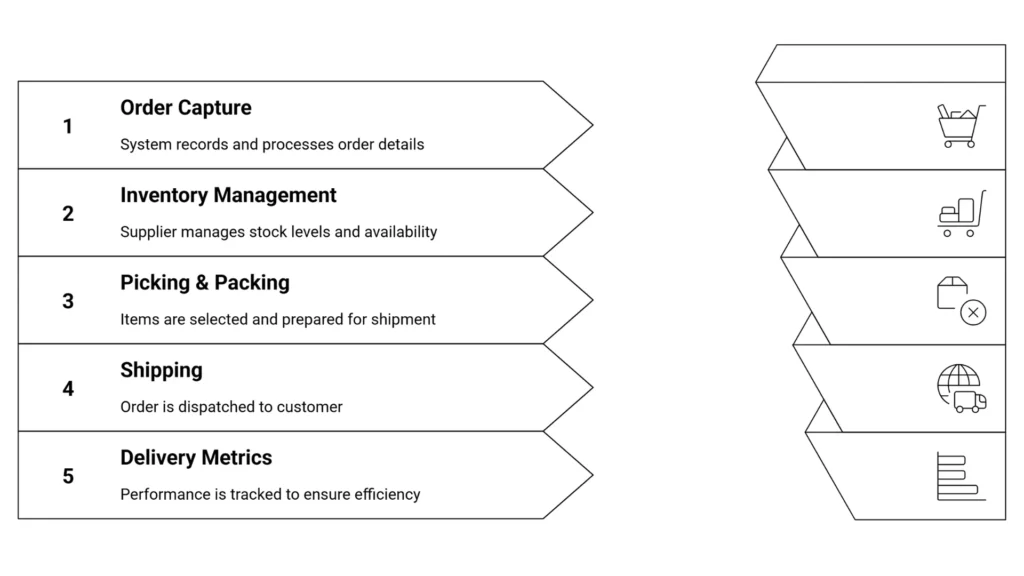
Here is a step-by-step guide to the working of dropshipping fulfillment.
1. Order Capture And Transmission
The process starts when the customer visits the website of the online seller and places an order. The order details, like type of product, quantities and shipping address, are sent to the dropshipping supplier through the order management system or API integration.
2. Warehousing And Inventory Management
Traditional fulfillment models require a business to store inventory. But in dropshipping, the online retailer does not need to build a warehouse and store inventory. The dropshipping supplier manages the stock and allows the retailer to focus on marketing and sales.
3. Picking, Packing & Shipping
The warehouse staff of the dropshipping supplier picks up the ordered product and does a thorough packaging and labelling so that the product will not get damaged during transit. The packaging includes the logo or branding of the online retailer. The staff then hand over the packaged product to the shipper.
4. Delivery And Fulfillment Metrics
The shipper delivers the product to the customer's doorstep. The online retailer tracks key things like order processing time, customer satisfaction ratings, delivery time, and many more, and assesses the performance of the dropshipping supplier.
5. Return And Reverse Logistics
The returns process and refunds are even part of the dropshipping. If the customer does not like the ordered product because of the wrong size or improper quality, then they place a return request by visiting the website. The details are then sent to the dropshipping supplier. The supplier arranges the pick-up and collects the product from the customer.
Benefits Of Dropshipping Fulfillment For Retailers & Suppliers
Benefits For Retailers
1. Saves cost
The online retailer does not have to invest money in storing its products or managing them, or in logistics. They do not have to invest in advanced technology like a warehouse management system, AI, or robotics to speed up the order fulfillment process. So dropshipping fulfillment saves the enormous cost of the online retailer.
2. Sell Various Products
The online retailer can list thousands of products on its website without storing and managing them. The retailer only needs to send the order details to the supplier.
3. Focus Only On Sales And Marketing
The online retailer can focus only on sales and marketing without worrying about the warehousing, logistics, and inventory management.
4. Easy To Set Up
An online retailer can start a business in just three steps, i.e, identify products, manage a third-party supplier, and set up an online store. These three things an online retailer has to do only in the dropshipping model. An online retailer with minimal experience in the e-commerce market can easily start up a dropshipping model.
5. Less Risk
An online retailer does not keep products in stock in the dropshipping model. So the retailer does not have to worry about outdated inventory or a rise in warehouse costs.
Benefits For Suppliers
1. Sell a Lot of Customers
Dropshipping suppliers can sell products to numerous customers without managing sales and marketing.
2. Generate Important Data And Take Decisions Effectively
A dropshipping platform integrates directly with the platform of the online retailer. This helps a seller to generate valuable data related to sales trends and geographical preferences, and they can do inventory planning effectively.
Challenges and Risks In Dropshipping Fulfillment
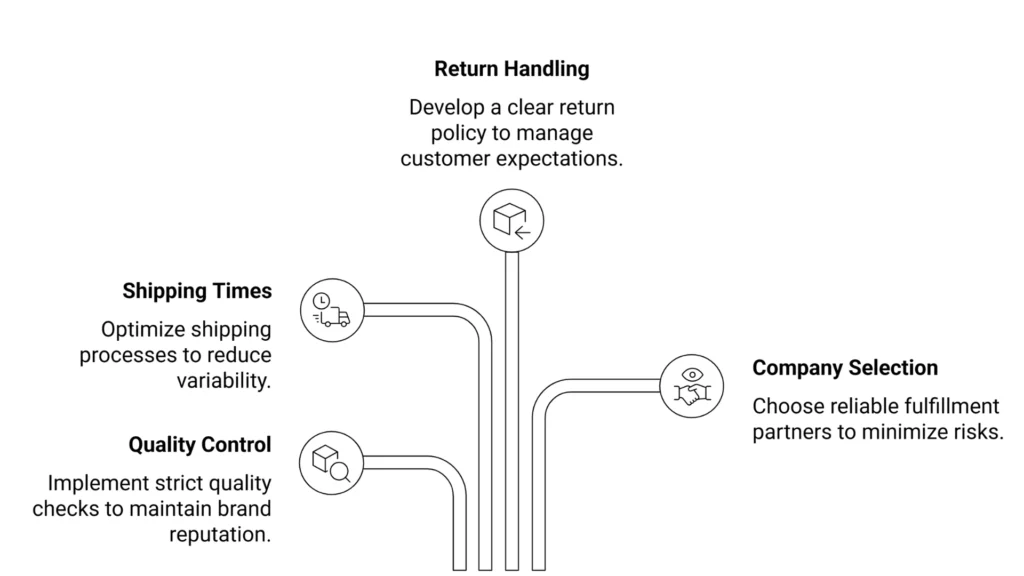
Dropshipping fulfillment even comes with a few challenges. Here is a list of them below.
1. Quality Control And Brand Reputation
The retailer does not package the products directly. The dropshipping supplier or, on their behalf, a 3PL company does picking, packing, and shipping the products. So the online retailer has limited control over the packaging and branding. If the supplier or 3PL ships the wrong items or there are any issues with the packaging, then it adversely affects the brand reputation of the online retailer or seller.
2. Longer Or Variable Shipping Times
Today, as hyperlocal delivery rises, customers expect their ordered products to reach them as fast as possible. But the order delivery can be late if the online suppliers have entered into a partnership with the International manufacturers or suppliers.
The online retailer can work with regional or local suppliers to deliver products faster to the customers.
3. Return Handling
Managing returns and refunds is quite complex if the online retailer has a partnership with International manufacturers or suppliers.
The online retailer should use return management software to track the return process efficiently. The retailer should even discuss the return policies before entering into a partnership with any International supplier.
4. DropShipping Fulfillment Companies Selection Risks
If an online retailer chooses the wrong third-party manufacturer or supplier, it can lead to late delivery and unreliable service. It can have a bad reputation for the brand in the market.
Process Of Choosing The Right Dropshipping Fulfillment Company
Selecting the right dropshipping fulfillment company is one of the essential steps in the dropshipping model. Here are a few factors that an online retailer should consider to grow its business in this competitive market. Here is a list of them below.
1. Define Business Needs
An online retailer should first identify its requirements before choosing the dropshipping fulfillment Company. For example, it should clearly identify its targeted customers, expected order volume, type of packaging, product size, and integration with its platform.
2. Evaluate Key Selection Criteria
An online retailer should verify a few things before choosing a dropshipping fulfillment Company. For example, it should choose a company that has warehouses in multiple regions of India. This ensures faster last-mile delivery and enhances customer satisfaction. The online retailer should even verify their logistics partners or carriers and ensure that the carrier does both National and International shipping effectively. The dropshipping fulfillment Company should even provide customised packaging and should seamlessly integrate with the e-commerce platforms of the online retailer.
3 . Compare Providers Using A Structured Framework
An online retailer should use a structured framework to compare various dropshipping fulfillment companies. It should do a comparison based on multiple factors like delivery speed, warehouse locations, integration, branding support, cost, and many more. This will help an online retailer choose the best dropshipping fulfillment partner.
4. Check Reviews And Case Studies
The online retailer should check reviews and testimonials of the dropshipping fulfillment partner and finally choose the one with good reviews or testimonials. The online retailer should prefer to choose the dropshipping fulfillment company that has experience in its industry.
5 . Pilot Test Before Doing Full Partnership
The online retailer should first do a trial phase, i.e, by processing a small number of orders through the provider and assessing a few things like delivery speed, packaging quality, and customer feedback, before entering into a long-term partnership.
Best Practices To Get Success In Dropshipping Fulfillment
Achieving success in the dropshipping model requires considering a few factors beyond just listing products online. The factors are in the list below.
- An online retailer should choose products that have constant demand in the market and have low return rates.
- An online retailer should partner with a third-party supplier that has warehouses in multiple locations. It should have a good track record and ensure that it delivers products faster to customers.
- The online retailer should use advanced software like an order management system to integrate with the platform of a dropshipping fulfillment company.
- The online retailer should clearly define the shipping policies on its website.
- The online retailer should even track the performance of the dropshipping fulfillment company from time to time.
Final Words
Dropshipping is a lucrative model which allows online retailers to grow without investing in warehouse infrastructure, inventories and logistics. It will enable online retailers to focus only on marketing and enhancing customer experience. Here, the third-party suppliers or manufacturers handle storage, packing and shipping activities for online retailers.