
Table of content:
- What is 3PL Ecommerce Fulfillment?
- Step-by-Step Working Process Of 3PL E-Commerce Fulfillment
- Benefits Of Using A 3PL For E-commerce
- Common Challenges In 3PL E-commerce Fulfillment And How To Mitigate Them
- How to Choose the Right 3PL for E-commerce Fulfillment?
- E Commerce 3PL Fulfillment Pricing Models and Cost Examples
- Final Words
- Frequently Asked Questions — 3PL Ecommerce Fulfillment


The Indian 3PL market is experiencing significant growth today. It is estimated to reach $48.59 billion by 2030. This growth is mainly due to the rise of e-commerce companies in India.
Storing products and delivering them on time to customers is quite challenging for an e-commerce business, especially if it handles everything in-house. Partnering with a 3PL ecommerce fulfillment provider has various benefits. 3PL stores products for an e-commerce business and efficiently manages, picks, packs, and ships them. An ecommerce 3PL provider even delivers products on time and enhances customer satisfaction.
What is 3PL Ecommerce Fulfillment?
3PL ecommerce fulfillment refers to outsourcing storage, handling, and shipping to a third-party logistics provider.
Handling the storage and packaging of ordered products, as well as shipping them, is an integral part of the supply chain and logistics process. Small and medium-sized enterprises can partner with a 3PL fulfillment provider and save costs. Seasonal sellers can manage storage and order fulfillment effectively without owning a warehouse operation. A D2C brand can focus on core activities of the business without worrying about the supply chain operations and 3PL ecommerce fulfillment process.
Step-by-Step Working Process Of 3PL E-Commerce Fulfillment
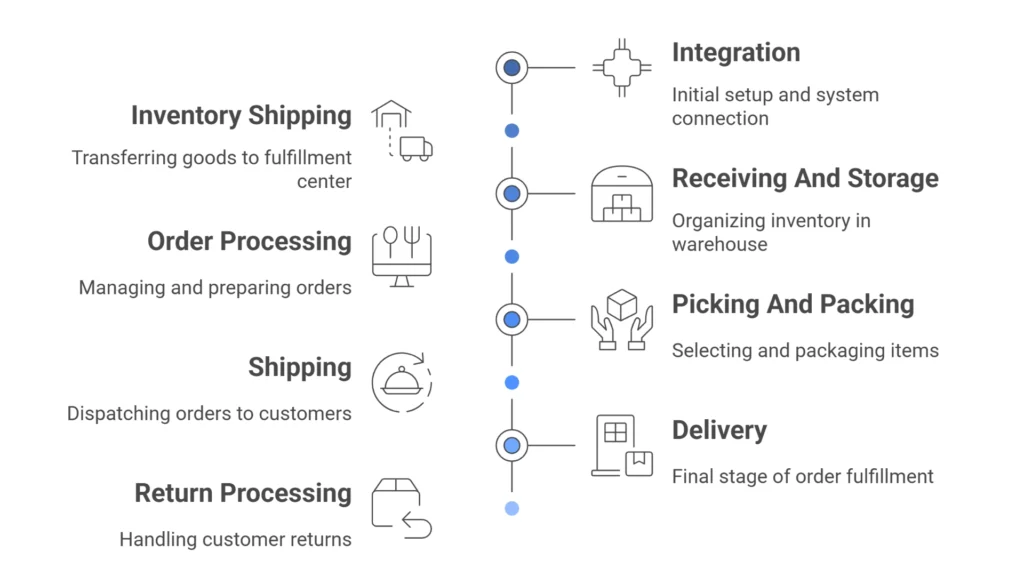
Here is a step-by-step guide to the working of 3PL e-commerce fulfillment.
1. Integration
The e-commerce business integrates its sales channels with the 3PL ecommerce fulfillment provider. This ensures seamless communication between the e-commerce business and the 3PL fulfillment provider.
2. Inventory Shipping
The e-commerce business ships its goods and products to the warehouse of the 3PL fulfillment provider. Once the shipment arrives at the warehouse facility, it is unloaded and prepared for the next stage, where the items are checked, counted, and verified before being stored in the warehouse.
3. Receiving And Storage
The 3PL ecommerce fulfillment staff thoroughly checked, counted, and verified against the shipment details and ensured they did not receive any damaged items. They enter the product information into the WMS or IMS software, and then store it in designated locations or according to its size and weight.
4. Order Processing
Whenever a customer orders a product from the e-commerce business, the order details are received automatically on the 3PL fulfillment provider's system. The order details include the shipping address and the quantity of products ordered.
5. Picking And Packing
The 3PL fulfillment staff picks up the ordered products and then sends them to the packaging station. The ordered product is thoroughly packaged to ensure they are not damaged during transit.
6. Shipping
The ecommerce 3PL provider then selects the carrier and shipping method based on the delivery preferences or instructions provided by the e-commerce business. The 3PL ecommerce fulfillment service provider attaches a shipping label to the packaged product and then hands it to the shipper.
7. Delivery
The shipping carrier delivers the product to the customer's doorstep. The delivery time can vary depending on shipping method, destination, or other factors.
8. Return Processing
Sometimes the customer does not like the ordered product and places a return request. The staff collects the ordered product from the customer and then returns it to the warehouse. The staff thoroughly inspects the product and then determines whether to restock, recycle, or refurbish it.
Benefits Of Using A 3PL For E-commerce
Partnering with a 3PL e-commerce fulfillment provider offers numerous benefits. Here is a list of them below.
1. Saves Cost
Storing products requires building a warehouse, managing staff, and purchasing equipment, such as forklifts. These all require a significant investment, which may not be feasible for small and medium-sized enterprises. Partnering with a 3PL ecommerce fulfillment company has various benefits, including a warehouse for storing products. So a small or medium-sized enterprise does not have to build a warehouse or purchase equipment. So this saves the costs of a business.
2. Scalability
Your business may experience high demand for products during a particular season or around holidays. It can even expand in the future. A 3PL ecommerce fulfillment provider offers scalable solutions, which means it can accommodate an increasing number of products as a business grows in the future.
3. Speed And Geographic Reach
A third-party ecommerce fulfillment provider has fulfillment centres in various regions, and, therefore, they deliver faster to customers. This enhances customer satisfaction with the business.
4. Operational Specialisation
A 3PL ecommerce provider has expert staff, and they specialize in order processing, value-added services, customization, and logistics services. They can even handle hazardous goods and temperature-sensitive products with great effectiveness.
Common Challenges In 3PL E-commerce Fulfillment And How To Mitigate Them
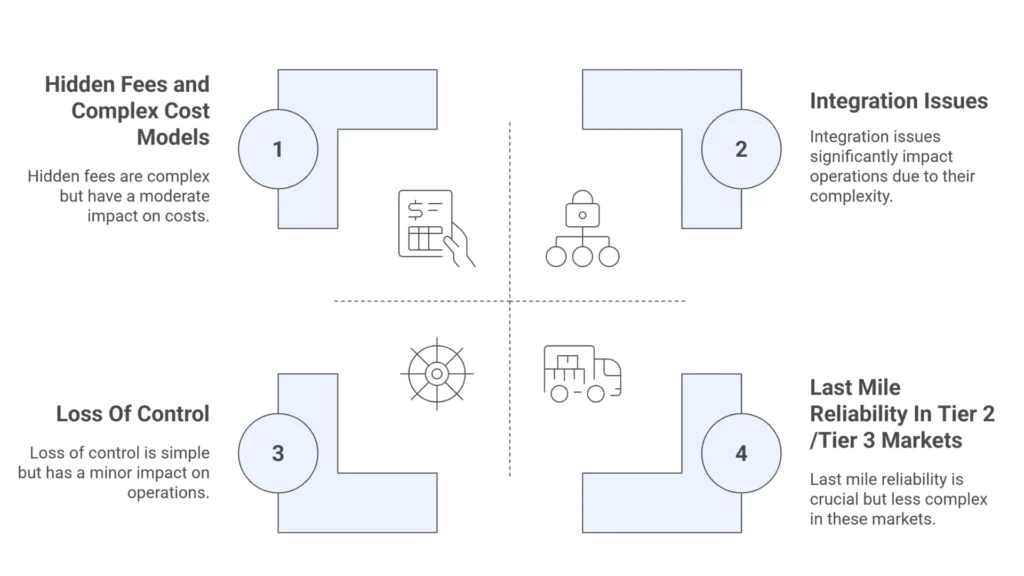
There are several challenges when a business partners with a 3PL ecommerce fulfillment company. Here is a list of them below.
1. Loss Of Control
A business has no control over packaging, shipping, or branding when it partners with a 3PL ecommerce fulfillment provider. A business should always choose a 3PL ecommerce provider that allows for custom packaging and branding.
2. Hidden Fees and Complex Cost Models
There are some logistics providers that have hidden fees for return processing or special handling. A business should request a detailed cost breakdown before entering into a partnership with a third-party logistics ecommerce fulfillment provider.
3. Integration Issues
Technical problems between the e-commerce business and the third-party logistics provider can delay the order fulfillment process. This can negatively impact the brand's reputation in the market.
A business needs to test the data flow for orders or tracking updates before entering into a partnership with a 3PL for ecommerce fulfillment.
4. Last Mile Reliability In Tier 2 /Tier 3 Markets
Some 3PL companies in India provide inconsistent service quality in smaller towns or remote areas. It can delay goods delivery and can have a bad reputation in the market.
A business should partner with a 3PL for ecommerce that has a strong regional network. It should deliver products efficiently in small towns or rural areas.
How to Choose the Right 3PL for E-commerce Fulfillment?
There are various third-party logistics e-commerce fulfillment providers. However, not all of them offer the same services. An e-commerce business needs to consider several factors before selecting a 3PL fulfillment provider.
1. Evaluation Criteria
An e-commerce business can use a weighted scoring model to compare 3PL fulfillment providers. For example, a company needs first to identify its key supply chain and logistics requirements, such as network coverage, pricing, risk management, and many others. It should then assign a weight percentage to each requirement and search for a 3PL logistics company in India accordingly.
2. 3PL Comparison Table
A business can use a table format to compare various third-party logistics providers by considering multiple key factors, such as warehouse locations, integration, return handling, customization, and more. This will help an e-commerce business to compare various 3PL fulfillment services for ecommerce in the market and choose the best one.
E Commerce 3PL Fulfillment Pricing Models and Cost Examples
| Features | Description | Example |
| Storage fees | A 3PL company charges storage fees for storing inventory in the warehouse. | Example - A 3PL provider can charge Rs15 to Rs30 per cubic foot of products stored in the warehouse every month. |
| Pick and pack fees | A 3PL provider charges for picking and packaging ordered products. | Example: A 3PL provider can charge Rs20 to Rs40 for picking nd packaging each ordered product every month. |
| Outbound shipping charges | A 3PL provider charges for last-mile delivery to the customer. | Example: a 3PL e-commerce fulfillment provider can charge between Rs40 to Rs80 if the ordered product is less than 500 grams and needs to be delivered within the city. The price can increase if the product needs to be delivered outside the city or weighs more than 500 grams. |
| Return processing | The 3PL e-commerce fulfillment provider charges for processing returned items. | A 3PL for e-commerce can charge Rs 30 to Rs 70 for processing each returned product. |
| Kitting and assembly | A3PL for e-commerce charges for creating combo packs or special gifts. | A 3PL for e-commerce fulfillment charges Rs 10 to RS 25 per kit. |
Final Words
Effective supply chain and logistics are highly essential today for an e-commerce business. But maintaining storage, picking, packaging, and shipping can be quite time-consuming for an e-commerce business. A slight delay in order fulfillment can have an adverse effect on brand reputation. Hence, an e-commerce business should partner with a third-party logistics (3PL) fulfillment provider. It has various benefits, like logistics cost savings. However, the company needs to choose a 3PL fulfillment provider by considering factors such as technology access, scalability, last-mile delivery, and many others.