
Table of content:


Fulfillment hub enhances the supply chain efficiency of the business. They not only store inventories but also do picking, packaging, shipping, and reverse logistics. They are equipped with advanced technology and are situated closer to target customers. Hence, they deliver products on time and enhance customer satisfaction.
What Is Fulfillment Hub?
A fulfillment hub is the backbone of a business's logistics. It is a specialized warehouse facility where businesses can store their inventory. When a customer orders any product from the website or ecommerce marketplaces in India, the order details are sent automatically to the fulfilment hub. The staff picks up the ordered product from the fulfillment center, does the through packaging, and hands it to the shipper. The shipper finally delivers the product to the customer's doorstep.
Thus, a fulfillment hub manages all the essential supply chain operations processes and allows a business to focus on core activities like developing new products or exploring new markets to expand the business.
How does Fulfillment Hub work?

A fulfillment hub ensures that every product moves smoothly from the warehouse to the customer. Here is a step-by-step procedure regarding the working of the fulfillment hub process.
1. Receiving Goods
The fulfillment hub receives goods from the seller. The staff of the fulfilment hub inspects the goods thoroughly to ensure no damaged products are stored in the storage facility.
2. Storage
The workers of the fulfillment hub enter the products in the advanced software, like a warehouse and inventory management system, and then store them in their designated places, like cabinets and racks. The staff mainly do storage depending upon the product size, weight, and demand in the market.
3. Picking And Packaging
The fulfillment hub receives all the order details when the customer buys a product from the website. The staff picks up the ordered product from the designated place and moves it to the packaging station. The requested product is thoroughly packed to ensure that it does not get damaged during transit.
4. Shipping
The fulfillment hub does a partnership with multiple transportation Companies. They deliver the products to the customer by air, road or rail.
Today, many businesses use advanced software like a transport management system and choose the most efficient route for product delivery. Customers receive the tracking information and monitor their products in real time.
5. Return Management
Sometimes the customer does not like the ordered product and places a return request. The staff from the fulfillment hub collect the product from the customer's house and bring it back to the hub. Certain workers inspect the product thoroughly and decide whether to restock, recycle, or refurbish.
Why Fulfillment Hubs Are Key To Faster Supply Chain?
Today, many businesses do not store products in a single warehouse. In fact, they store products in fulfillment hubs that are closer to the target customers. It lowers shipping costs and delivers products either on the same day or the next day. Thus, storing products in fulfilment hubs enhances customer satisfaction and brand reputation in the market.
Fulfillment Hub Versus Traditional Warehouse
- A fulfillment hub not only stores products but also focuses on order processing like picking, packaging and logistics operations. It ensures the smooth delivery of products to the customers. A traditional warehouse stores inventories for the long term but does not focus on picking, packaging products or shipping.
- A fulfilment hub usually leverages advanced technology like a warehouse management system and an inventory management system. These advanced software optimize the fulfilment hub layout and speed up the order processing. But traditional shared warehouses are usually not equipped with advanced software and technology. Manual methods are used for tracking inventories, which leads to errors.
- A fulfillment hub delivers products to the customer either on the same day or the next day and enhances customer satisfaction. But a traditional warehouse does not focus on the quick delivery of products.
Benefits of Partnering with Fulfillment Hub
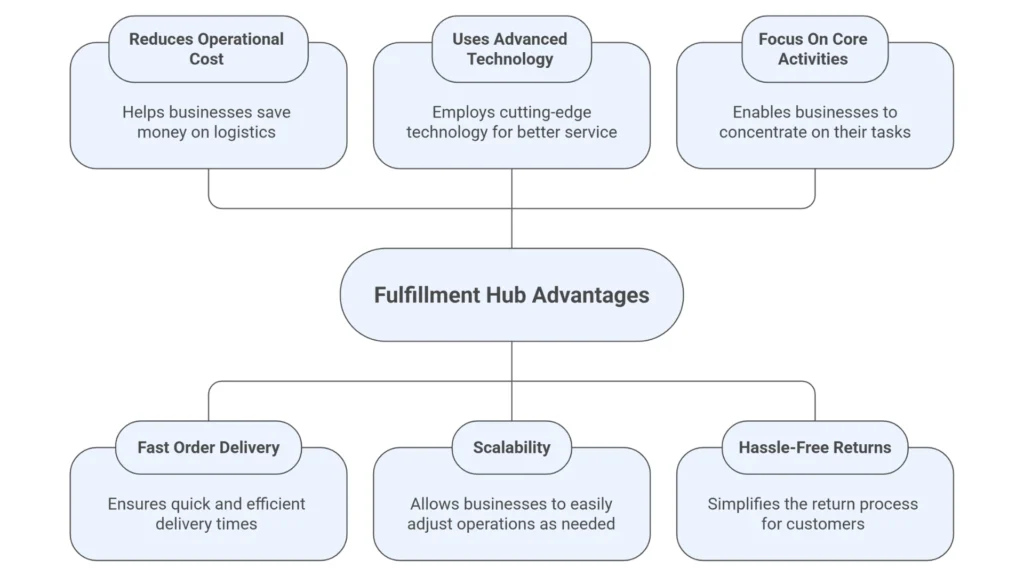
There are various benefits when a business partners with the fulfilment hub. Some of them are listed below.
1. Reduces Operational Cost
Building a warehouse, managing staff, and buying heavy equipment requires a lot of investment. This is quite challenging for a small and medium-scale business. A business can store products in the fulfillment hub and reduce warehousing costs.
2. Fast Order Delivery
Fulfilment hubs are present closer to the target customers. Hence, they deliver products faster and enhance customer satisfaction.
3. Uses Advanced Technology
Today, most of the fulfillment hubs use advanced technology like a warehouse management system, AI, and machine learning. It automates order processing steps and reduces human errors.
4. Scalability
Fulfillment hubs offer scalable warehouse solutions, which means they can accommodate products when the business grows in the future.
5. Focus On Core Activities
A fulfilment hub manages all the supply chain processes, like storage and shipping. This allows a business to focus on core activities like product development.
6. Hassle-Free Return Management
A fulfillment hub not only ships products but also manages the returns process efficiently. A separate team of the fulfilment hub inspects the returned product thoroughly and then decides whether to restock or refurbish, or recycle.
The Future Of Fulfillment Hubs
- Most of the hubs will use AI, robots, and machine learning for optimizing warehouse operations and avoiding problems of overstocking or understocking.
- Fulfillment hubs will use electric feet for transporting products to the customers. This reduces the fuel costs of the business.
- Micro fulfillment centers will be set up in the coming years, which will deliver products to customers within a few hours.
Final Words
A Fulfillment hub has become the cornerstone of modern logistics. It reduces cost and offers scalable solutions. It even allows a business to focus on core areas like product design and development. But there are various fulfillment centers in India. You need to select them by considering a few factors like their reputation, experience related to your industry, access to technology, and many more.