

Table of content:
- What Is Physical Inventory?
- Why Does Business Conduct Physical Inventory?
- Types Of Physical Inventory Counting Methods
- Physical Inventory Process
- Common Challenges In Physical Inventory
- Best Practices For Accurate Physical Inventory
- Technology And Tools Used In Physical Inventory
- When Should Businesses Conduct Physical Inventory?
- Final Words


Do you know that many businesses experience inventory inaccuracies of 20-30% due to human errors, theft, or system mismatches? These inaccuracies can lead to stockout issues, overstocking and financial losses.
Physical inventory involves counting all the inventory in the warehouse and matching it with the system records. This improves accuracy, reduces errors and improves order fulfilment speed.
Physical inventory has an important role in various industries like manufacturing, e-commerce, and the retail industry. It ensures that the right products reach the customer at the right time and enhances customer satisfaction.
What Is Physical Inventory?
Physical inventory is a process of manually counting the stock in the warehouse and comparing it with the number entered in the inventory management system. It ensures that the records align with the actual stock present in the warehouse.
Why Does Business Conduct Physical Inventory?
1. Ensures Acuray
Businesses conduct physical inventory to ensure accuracy in records. Inventory management systems can have errors because of missed entries or technical glitches. Physical inventory compares actual data with the recorded data and identifies discrepancies. It allows warehouse managers to correct data in the system and improve the decision-making process.
2. Detect Losses Or Theft
Sometimes, inventories can get stolen or damaged during handling. The staff may forget to update it in the system. Physical inventory allows warehouse managers to identify such discrepancies and their root causes and take corrective actions.
3. Prevent Stockouts Or Overstocking
If inventory records are inaccurate, then the warehouse can either have too much inventory or run out of stock. Storing a lot of inventory can increase storage costs and increase the risk of product damage. Simultaneously storing less inventory can lead to lost sales opportunities and dissatisfied customers.
Physical inventory allows businesses to plan better purchasing and restocking strategies.
4. Helps In Financial Reporting And Compliance
The value of inventory directly affects the cost of goods sold and profit margins. If the inventory value is inaccurate, then the financial statements will also become inaccurate. Physical inventory ensures that the reported inventory value matches the actual stock, which is important for tax filings and audits.
5. Improves Order Fulfilment Efficiency
Physical inventory improves the order fulfilment efficiency of the business. It ensures that the right products are present in the proper location. It allows warehouse staff to easily pick the ordered product, package it and hand it over to the shipper for delivery.
Types Of Physical Inventory Counting Methods
There are various physical inventory counting methods. They are in the list below.
1. Full Physical Inventory Count
In this method, the staff counts all the stock in the warehouse either once or twice a year. The warehouse needs to stop all the operations so that staff can count them properly. A full physical inventory count is quite a time-consuming process. It is best for small and medium enterprises.
2. Cycle Counting
Cycle counting involves counting small portions of inventory on a regular basis instead of counting all the stock in a year. This method will not halt any warehouse operations and allows managers to identify discrepancies early. Cycle counting keeps inventory records accurate at all times.
3. Spot Checking
Spot checking involves checking a few random stocks in the warehouse. Warehouse managers usually prefer spot checking when finding missed stock or system errors. This method quickly identifies issues in a specific area. But it does not give a complete overview of the inventories stored in the entire warehouse.
4. ABC Inventory Counting
In this method, the warehouse staff is divided into three classes based on their value and importance in the market.
Class A Items: Class A items are highly valuable and require close monitoring. They require frequent counting as they have a higher impact on profits. They are around 10-20 per cent of the total stock in the warehouse but contribute 70-80percent of the total revenue.
Class B Items: Class B items are not as valuable as Class A items. However, they still require moderate attention. The staff needs to count these items on a regular basis.
They are usually present around 20-30 per cent of the total stock in the warehouse and contribute 15-25 per cent of the total revenue.
Class C Items: Class C items are not as valuable as class A and class B items. They are usually 50-70 per cent of the warehouse's total stock and account for only 5-10 per cent of total revenue. Warehouse staff don't need to count them often.
Physical Inventory Process
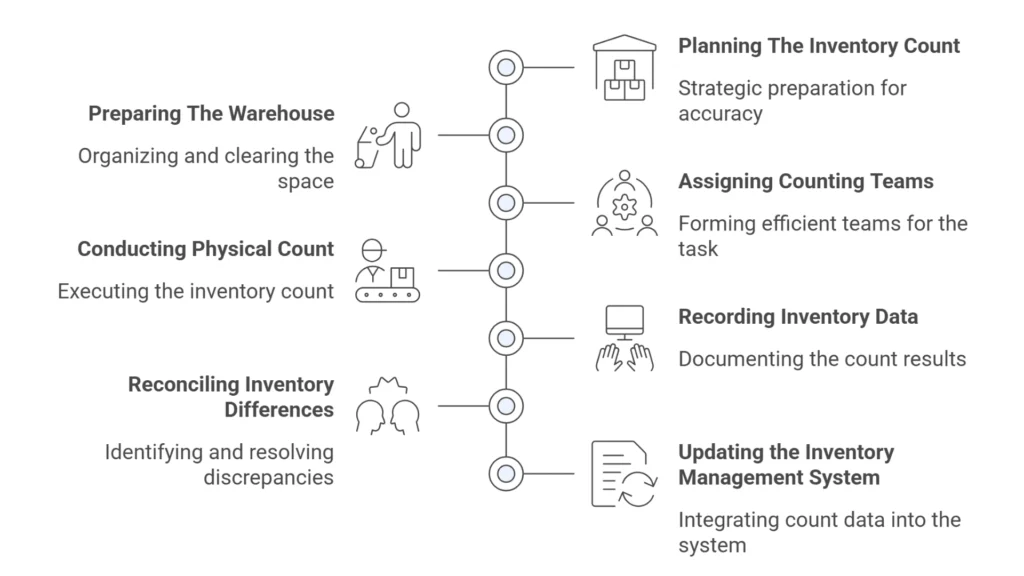
Here is a step-by-step guide on the physical inventory process.
1. Planning The Inventory Count
The first step is to decide which method to execute for physical inventory counting, like cycle counting or a full physical inventory count. Secondly, the warehouse manager needs to decide when staff will perform physical inventory counting. Proper planning prevents confusion and ensures operations run smoothly.
2. Preparing The Warehouse
The staff needs to organise the warehouse before starting the physical inventory count. Products should be in the designated locations. They should have proper labels for easy identification. The staff even needs to separate the damaged products.
Proper counting of the warehouse items makes the counting process easier and faster.
3. Assigning Counting Teams
The warehouse manager divides teams into groups and assigns them locations where they will be doing physical inventory counting. The manager gives proper instructions to the staff so that they can effectively count. Assigning responsibilities and giving proper training reduces errors and increases efficiency.
4. Conducting Physical Count
Warehouse staff start to count the stock in their assigned locations. Sometimes they need to count products twice to ensure accuracy.
5. Recording Inventory Data
The staff needs to record the quantities of the stock on data sheets or digital systems. Accurate recording is highly essential to avoid errors.
6. Reconciling Inventory Differences
The staff then compares the data from physical counting with that recorded in the system. Businesses need to investigate the reasons if there are any discrepancies.
7. Updating the Inventory Management System
The staff updates the correct value on the inventory management system. Correct data related to stocks to avoid problems like overstocking and understocking, and improve the order fulfilment process.
Common Challenges In Physical Inventory
Physical inventory comes with certain challenges. They are in the list below.
1. Warehouse Operational Disruptions
Physical inventory can interrupt normal warehouse operations. It causes delays in picking ordered products, packaging, and shipping. Delays in the order fulfilment process decrease customer satisfaction and negatively affect brand reputation in the market.
Warehouse managers need to plan physical inventory at a time so that it will not halt warehouse operations.
2. Human Counting Errors
Manual counting usually leads to errors. The staff needs to count a second time to ensure accuracy, which consumes time. Warehouse staff can use tools like barcode scanners to improve accuracy.
3. Large Inventory Volume
Counting a large number of inventory volumes is quite a time-consuming process. It even leads to errors, especially when staff count manually.
Best Practices For Accurate Physical Inventory
1. Train Warehouse Staff Properly
Warehouse staff should get proper training regarding how to count items and record them effectively. This will reduce errors like double-counting and missing items.
2. Divide Warehouse Into Zones
Businesses can divide the warehouse into various zones and assign each counting team to a specific zone. The counting team is responsible for counting the items properly only in the allotted zone. This method improves the efficiency of the physical inventory count.
3. Conduct Precount Audits
Businesses should organise the stock properly and check the labels before a physical inventory count.
4. Use Barcode Or RFID Technology
Counting all the stock manually in a large warehouse consumes a lot of time and can lead to errors. A warehouse can implement barcode or RFID technology to count inventory faster. They just need to scan the items instead of doing manual entry, which reduces errors.
Technology And Tools Used In Physical Inventory
There are various tools that businesses can utilize to increase the efficiency of physical inventory.
1. Warehouse Management System
It is an advanced software that tracks inventories inside the warehouse. It organises the warehouse in an efficient way and speeds up the periodic inventory process.WMS even generates reports related to stock levels and discrepancies.
2. Barcode Scanners
These are devices by which workers need to scan the product labels, and the system automatically updates information about the product. So barcode scanners reduce human errors and speed up the counting process.
3. RFID Tracking System
RFID tracking systems use wireless technology to track and identify multiple products at once. Each product in the warehouse has an RFID tag. The staff just placed the RFID readers at key locations of the warehouse. The RFID reader automatically scans the inventories in the warehouse and updates them in the system. This makes the physical inventory counting faster and error-free.
When Should Businesses Conduct Physical Inventory?
- Most businesses conduct physical stock counting at the end of the financial year to ensure that data in the system is correct for financial reporting and auditing.
- Some businesses conduct physical stock counts before peak seasons to ensure they have enough stock in the warehouse to meet customer demand.
- Small businesses conduct physical stock at the end of the financial year, while medium- to large-sized enterprises conduct physical inventory monthly or quarterly.
- Some businesses conduct physical stock counts when they notice discrepancies between system records and actual stock in the warehouse.
Final Words
Physical inventory is a vital process that helps businesses maintain accurate stock records and improve order fulfilment efficiency. Manual counting of all warehouse stock is time-consuming and prone to error. Businesses can utilize technologies such as barcode scanning and RFID to speed up and improve the efficiency of physical inventory counting.