
Table of content:
- What Is Wavepicking In Warehouse Operations?
- How Wave Picking Differs From Continuous Picking?
- Why High Volume Warehouses Need Structured Picking Strategies?
- How Wave Picking Works: Step-by-Step Operational Process
- Types Of Wave Picking Strategies Used In Modern Warehouses
- Wave Picking VS Batch Picking VS Zone Picking VS Cluster Picking
- Key Technologies Supporting Modern Wave Picking
- Operational Benefits Of Wave Picking
- Challenges Of Implementing Wave Picking
- When Should A Business Implement Wave Picking?
- Future Of Wave Picking
- Final Words


Ecommerce warehouses now process thousands of small orders every day. According to industry reports, order picking alone can account for nearly 50–55% of total warehouse operating costs. When pickers move randomly across the warehouse, travel time increases and shipments miss carrier cut-off times.
Wave picking solves this operational gap. The warehouse management system groups orders based on shipping deadlines, order size, or shipment schedules. The system then releases these orders in planned waves, so pickers work on structured tasks instead of scattered orders.
High-volume fulfillment centres rely on this method to reduce picker travel time, balance labour, and align picking with dispatch schedules. When the warehouse runs multizone operations and handles large SKU counts, wave picking helps maintain faster order processing and consistent outbound flow.
What Is Wavepicking In Warehouse Operations?
Wave picking is an order fulfillment strategy in which advanced software, like a WMS or IMS, groups orders based on various factors like due date, order size or shipping date. This allows warehouse staff to pick orders quickly without moving back and forth to collect a single ordered item.
Wave picking allows you to pick ordered products faster and enhances the order fulfillment efficiency. This increases customer satisfaction and improves brand reputation in the market.
This picking strategy becomes essential when the warehouse facility handles high order volumes daily and has multizone picking environments.
How Wave Picking Differs From Continuous Picking?
| Wave picking | Continuous picking |
| The system groups orders and then releases them in batches. | Orders are released immediately after entering the system. |
| Require structured wave planning | Minimal preplanning is necessary |
| Supports large order volumes and dispatches them according to shipping timeline. | Supports small orders and may or may dispatch according to shipping timeline. |
| Ideal for ecommerce and fulfillment centers. | Ideal for low volume warehouses. |
Why High Volume Warehouses Need Structured Picking Strategies?
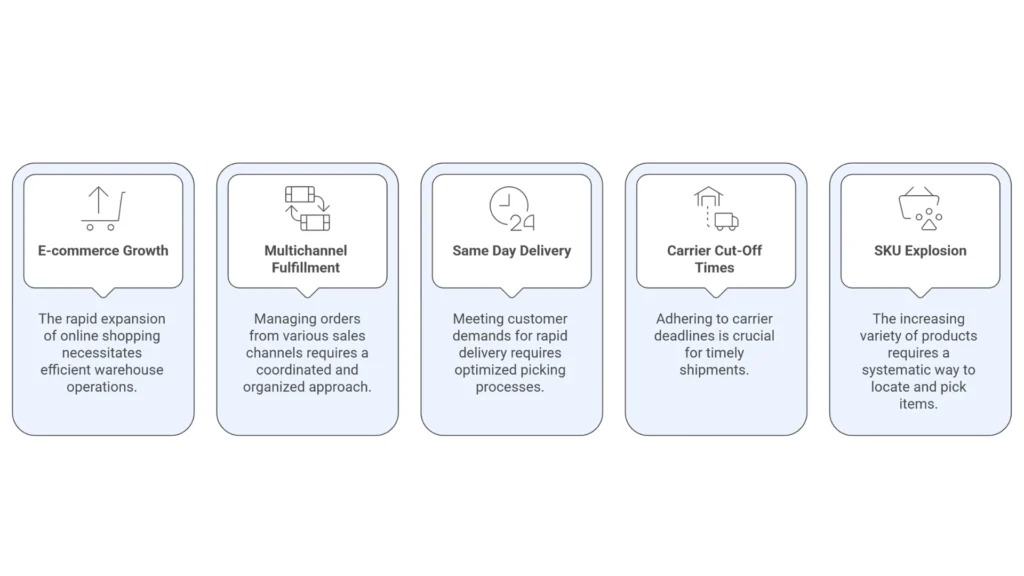
1. E-commerce Growth
E-commerce growth has significantly changed warehouse operations. The earlier warehouse was transporting large and bulk orders to retailers. The warehouse staff was picking cartons or pallets and transporting products to retailers. However, today, warehouse staff handle thousands of small orders daily.
The e-commerce businesses often generate high product returns. The staff needs to inspect them properly and then decide whether to restock or refurbish.
The warehouse needs to be organized and should have structured picking strategies to fulfill a lot of orders and manage returns effectively.
2. Multichannel Fulfillment
Modern warehouses handle orders from various channels at the same time, like B2B and D2C.
Each channel has different packing strategies and service level agreements. All ordered products can get mixed if the warehouse does not follow a structured picking strategy. This can further dissatisfy customers and decrease brand reputation in the market.
So, multichannel fulfillment should implement structured picking strategies to fulfil orders effectively across all the channels.
3. Same Day Delivery Expectations
Today, customers' expectations have increased with the increase in online shopping. They expect their ordered products to arrive on the same day or the next day. They even expect to track their shipments in real time.
If the warehouse makes a delay in delivering, then they cancel the order or do not buy from the particular brand.
The warehouse needs to be organized and use structured picking strategies to deliver products faster to the customers.
4. Carrier Cut-Off Times
The shipping companies set a time, and within that time, they accept packaged products ordered. The warehouse needs to pick and do proper packaging within that time to hand over to the shipper. If the warehouse cannot do so, then that will cause a delay in product delivery to customers.
The warehouse needs to adopt structured picking strategies to hand over the packaged products within the time limit.
5. SKU Explosion
SKU explosion means a rapid increase in stock-keeping units in the warehouse. Let us discuss with an example. A T -shirt business does a partnership with a warehouse when it has small order volumes. However, as the business expands, it has a short list of various brands. Each brand has different colours and sizes.
Picking becomes more complex when managing a lot of products. It even increases the travel time of the warehouse staff. The warehouse needs to use effective picking strategies to manage the SKU explosion effectively.
How Wave Picking Works: Step-by-Step Operational Process
Here is a step-by-step guide on the working of wave picking.
1. Order Pooling
Order pooling is the first step in wave picking. Here, the warehouse staff does not immediately pick ordered products. The warehouse management system gathers all the orders from various sources like marketplaces, ecommerce websites and many more in one pool. The software further analyzes the order based on their shipping guidelines and the size and shape of the product.
2. Wave Criteria Configuration
Here, the warehouse management system uses specific rules to have a structured picking strategy in the warehouse. It groups the ordered products based upon factors like shipping carrier, delivery deadlines, product type or order size. Wave criteria configuration reduces travel time and allows staff to pick and pack orders before the shipping deadlines.
3. Wave Release
The warehouse management system then sends the grouped orders to the pickers based on factors like product size or order type. The software then automatically creates picking tasks for the workers. Each picker in the warehouse will receive instructions related to picking, such as which items they need to collect and where they are present in the warehouse.
Wave release is highly essential because it controls the workflow inside the warehouse. It prevents overcrowding and allows pickers to pick ordered products correctly.
4. Picking And Consolidation
The warehouse workers start picking the ordered products. They move from one area of the warehouse to another and collect the ordered products from the shelves or racks. The picker then sends all the ordered products to the consolidated area. The staff in the consolidated area use scanners or check annually that all the products collected from different warehouse zones are as per the details listed by the warehouse management system. The staff group in the same order and send it to the packaging station.
5. Packaging And Dock Allocation
The packaging staff once again checks the products and ensures that they are the right products and quantities as per the system-generated list. They then pack the ordered products with bubble wrap, boxes or protective covers so that the products do not get damaged during transit.
The staff then attaches the printed shipping label to the packaged product. The shipping label clearly mentions important information like customer address, order number and shipping carrier. The staff further sends the packaging product to the dock area based on the carrier or delivery route.
Types Of Wave Picking Strategies Used In Modern Warehouses
Modern warehouses utilize various types of wave picking strategies. They are in the list below.
1. Time-Based Wave Picking
The time-based waving picking method does not process orders consistently. The warehouse management system groups order products and releases them for picking at specific times of the day.
2. Carrier-Based Wave Picking
The system groups ordered products based on the logistics partner and releases them. For example, the warehouse management system groups all the ordered products assigned to one shipping carrier company and releases them for picking. Carrier-based wave picking methods avoid shipment delays and improve coordination between picking, packing and shipping operations.
3. Zone-Based Wave Picking
This type of picking method is basically used in large warehouses with various zones. Each zone has various product categories. The warehouse management system releases a wave, and the picker of each zone is responsible for picking the ordered products assigned to them by the system. The pickers of each zone bring all the ordered products to the consolidated area. The staff combines the orders for packaging.
4. Priority/SLA Based Wave Picking
Here, the warehouse management system groups orders based on their urgency or service level agreements. Warehouse processes premium customer orders or urgent shipments first and then processes other products.
5. Hybrid Wave Picking
This method uses two or more wave picking strategies to manage complex warehouse operations. For example, a warehouse can use zone-based wave picking and carrier-based wave picking together to fulfil orders. Hybrid-based wave picking allows the warehouse to adjust picking strategies based on the order volume and shipping deadlines.
Wave Picking VS Batch Picking VS Zone Picking VS Cluster Picking
| Parameters | Wave picking | Batch picking | Zone picking | Cluster picking |
| Method | Here the system groups orders based on shipping deadlines or order size and releases orders at specific times of the day. | Here a single picker collects products for multiple orders in one trip. | The warehouse has various zones and each picker is assigned to each zone.Each picker is responsible for collecting ordered products only from the assigned zones. | Here the picker picks products for multiple orders at the same time and places them in separate bins. |
| Best For | High volume warehouse with fixed shipping schedules. | Small to medium warehouses | Large warehouses with various segment areas | Ecommerce fulfillment centers handling various small orders at a time. |
| Limitation | Require careful planning and coordination | Sorting items can take extra time. | Orders delays,dependency on coordination. | Requires good organisation |
| Tech Dependency | It requires a warehouse management system to plan and release waves. | It works with a basic system but can work good when the warehouse utilises advanced software like a warehouse management system. | It often requires WMS and scanning systems to manage various zones. | It requires hand held scanners and pick to light technology for tracking multiple orders. |
Key Technologies Supporting Modern Wave Picking
- Automated Wave Planning: Automated wave planning allows the warehouse management system to create picking waves automatically. Here, the managers do not manage orders manually.
- Rule-Based Wave Generation: The warehouse managers set predefined rules, and the system groups orders accordingly.
- Dynamic Scheduling: Dynamic scheduling allows wave-picking plans to change based on real-time conditions.
- Pick Path Optimization: It allows warehouse staff to follow the most efficient route for collecting ordered products.
Operational Benefits Of Wave Picking
1. Better Labour Utilization
Wave picking allows the warehouse to use its workers efficiently. Here, the staff does not pick items randomly from the shelves or racks. The system groups orders based on the shipping deadlines and order type and then releases them. Wave picking follows a structured approach and distributes tasks efficiently among the workers of the warehouse. It makes the warehouse operations smooth and efficient.
2. Controlled Dock Operations
The system releases orders based on dispatch timing in wave picking. So the products are picked, packaged and reach the dock based on shipping deadlines. This reduces dock congestion and enables smoother truck loading.
3. Scalability During Peak Seasons
The order volume increases during peak seasons and holidays. Wave picking allows warehouse managers to manage high-volume orders efficiently by adjusting the size and number of picking waves. Warehouse managers can release more waves in a day and assign additional staff to handle a lot of orders.
4. Reduce Idle Time Between Processes
Warehouse operations involve picking, packing and shipping. All the 3PL operations should be well coordinated with each other. They should happen in sequence.
Let us discuss with an example. If these processes do not coordinate with each other, then the warehouse staff will complete the picking and have to wait for packaging for a longer time, which will increase order fulfillment time and dissatisfy customers. Wave picking releases orders in a planned and controlled way. So staff can work consistently without waiting for a long time.
Challenges Of Implementing Wave Picking
Wave picking methods also bring a few challenges. They are in the list below.
1. Requires A Strong Warehouse Management System
Wave picking relies heavily on advanced software like warehouse management systems. This software helps in organizing orders, creating picking waves and releasing orders. Small and medium enterprises do not have enough money to adopt advanced software, and hence, they face challenges in using wave-picking methods.
2. Incorrect Wave Logic
Wave logic depends on proper planning and coordination. Orders can be placed in the wrong wave if they are not set correctly in the system. This can cause delays in picking, packaging and many miss shipping deadlines.
3. High Dependency on Real-Time Data Accuracy
Wave picking works best when the system has real-time data about the inventories and their locations. If the system does not have updated inventory data, then the wave picking method can create inefficiencies.
When Should A Business Implement Wave Picking?
E-commerce brands handle high order volumes daily, and to manage them, wave picking can be the best option.
3PL companies in India manage warehousing and order fulfillment for various businesses, and to manage them efficiently, they can utilize wave picking.
Growing SMS can utilize wave picking methods for processing larger order volumes.
Future Of Wave Picking
- AI-Based Predictive Wave Planning: A warehouse can utilize artificial intelligence for planning waves.
- Robotis Integration: A warehouse can integrate robots and automate systems with wave picking operations.
- ERP And TMS Integration: The wave picking method can integrate with ERP and TMS to enhance the efficiency of order fulfillment.
Final Words
A warehouse needs a structured picking method if it handles a large volume of orders daily. Today, most of the warehouses use the wave picking method to enhance order fulfillment efficiency. Here, the warehouse management system first groups orders based on order size or shipping deadlines, and releases orders at specific times of the day. It has various benefits, such as reducing idle time between processes and reducing dock congestion. However, it comes with various challenges. Every business cannot afford to use advanced software like a warehouse management system, and hence cannot utilize the wave picking method effectively.