
Table of content:
- What is Quick Commerce?
- How Quick Commerce Works?
- List of Top 10 Quick Commerce Companies in India
- How to Choose the Right Quick Commerce App in India for Your Products (Seller’s Guide)
- Benefits of Selling Products Through Quick Commerce Companies
- Conclusion
- Frequently Asked Questions — Quick Commerce Companies in India


Quick Commerce (Q-Commerce) and hyperlocal delivery have become very popular over the last few years. The word Quick Commerce defines fast and efficient delivery services. It usually delivers Products within a 10-minute to the customer's doorstep. The trend of Q-commerce has increased because people now expect quick delivery services, primarily in urban areas.
This sector is growing very fast in India, with a compound annual growth rate (CAGR) of over 4.5%. The Quick Commerce industry is valued at around $3.6 billion and is projected to rise to $13 billion by 2032. In 2024, India has around 26.2 million Q-commerce users on all platforms. Within 4-5 years, many big and small quick commerce companies have established them self in the Indian market. Some of them are doing very well, and some are doing decently. Let's explore this industry and what quick commerce is, and find out the top 10 quick commerce companies in India.
What is Quick Commerce?
It is the new segment of e-commerce that focuses on faster delivery. As we can understand from the word, quick commerce means fast e-commerce deliveries. The main aim of Quick commerce is to provide quick delivery when users place orders on quick commerce apps. As we know, e-commerce companies like Amazon, Flipkart, and Meesho take 1-3 days to deliver the ordered product; sometimes, it takes longer. However, in Q-commerce, companies deliver products within 10 minutes. Quick Commerce companies have technology and automation that speed up the process of order management, pick and pack, and delivery.
How Quick Commerce Works?
Quick commerce companies in India have dark stores in urban and populated areas. They work as micro fulfillment hubs but utilize advanced technology. These dark stores cover the 2-5 Km circle area around the location of the dark store. With the help of AI and advanced technology, Quick commerce companies identify ideal locations for dark stores and micro fulfillment hubs in strategic areas. Where they can receive enough orders to function. Let's see the process of the Quick Commerce companies' operation:
- Customers place the order through the Quick commerce apps.
- The dark store and the delivery boy received the customer's order.
- OMS identified the order and quickly processed and packed it.
- The order handed over to a delivery boy.
- Advanced route optimization systems suggest the shortest route.
- Order Delivered Within 20-30 minutes.
List of Top 10 Quick Commerce Companies in India
- Blinkit
- Zepto
- Swiggy InstaMart
- BigBasket Now
- Flipkart Minutes
- Jiomar Express
- Amazon Now
- M-Now (Myntra)
- Slikk
- FreshToHome
Comparison Table of Top Quick Commerce Companies
| Company | Founded | Core Category | Delivery Speed | Fulfilment Model | Dark Stores / Network | Cities Covered | Market Position / Key Highlights |
| Blinkit | 2013 | Grocery & Essentials | 10 minutes | Dark store–led | 1,544+ dark stores | 150+ | Market leader with ~50% market share, 750%+ YoY revenue growth, owned by Zomato |
| Zepto | 2021 | Grocery + Essentials | 10 minutes | Dark store–led | 900–1,100 dark stores | 50+ | Strong #2 player, shifted from kirana model to dark stores |
| Swiggy Instamart | 2020 | Grocery & Daily Needs | 10 minutes | Dark store–led | 1,000+ dark stores | 150+ | Backed by Swiggy, IPO in Nov 2024 ($11.3B valuation) |
| BigBasket Now | 2011 | Grocery & Essentials | 10 minutes | Dark store + large SKU hubs | 700+ dark stores | 50+ | Owned by Tata Digital, largest SKU depth (10k–30k SKUs) |
| Flipkart Minutes | 2024 | Grocery + Electronics | 10 minutes | Dark store–led | 500+ dark stores | 30+ | Rapid expansion, strong Tier-2 & Tier-3 push |
| JioMart Express | 2024 | Grocery & Essentials | 1 hour | Hybrid (Dark stores + Kiranas) | ~600 dark stores + kirana hubs | Major metros | Reliance-backed, strongest offline + kirana integration |
| Amazon Now | 2024 | Grocery & Daily Needs | 10 minutes | Dark store (MFCs) | 300+ dark stores | Major metros | Operates inside Amazon app, ultra-fast pilot scaled to metros |
| M-Now (Myntra) | 2024 | Fashion & Lifestyle | 2 hours | Brand-led fulfilment hubs | Limited / selective | Bangalore, Delhi, Mumbai | Premium fashion quick commerce, invite-only sellers |
| Slikk | 2024 | Fashion & Lifestyle | 60 minutes | Hyper-local fulfilment | Limited | Bangalore | Try-&-Buy model, Gen-Z focused, $10M Series A |
| FreshToHome | 2015 | Meat & Seafood | 60 minutes | Cold-chain hubs | Collection centres + hubs | 160+ | Leader in fresh non-veg, strong cold-chain logistics |
1. Blinkit:
Blinkit (Formerly known as Grofers) was founded in 2013 in Gurgaon. Initially, Blinkit was an online grocery store that delivered groceries within 1-3 days. After seven years of operations, Blinkit offers express grocery delivery service in India. In August 2021, they introduced 10-minute grocery delivery service in top 12 cities, such as Delhi, Gurgaon, Bangalore, Mumbai, etc. On 13 December 2021, Grofers changed its brand name to Blinkit. After 6-7 months, Zomato acquired Blinkit in 2022 with an all-share deal. Currently, Blinkit has more than 1,544 dark stores in 150+ cities across India. Blinkit has posted stellar year-on-year growth, with quarterly revenue jumping over 750% in late 2025 and consistent 100%+ YoY revenue increases in early 2026. Blinkit is one of India's biggest quick commerce companies because it has around 50% market share in the quick commerce sector.
2. Zepto
Zepto is also a well-known quick commerce company in India. It was founded in 2021 by 17-year-old Kaivalya Vohra and Aadit Palicha. Initially, Zepto focused on delivering groceries from nearby Kirana stores, offering a convenient and quick solution for daily household needs. However, this model did not perform as expected. To address the growing demand for quick commerce, they shifted their strategy in 2022 by setting up dark stores in different cities. These dedicated small retail warehouses allowed them to simplify operations and secure faster customer deliveries. Zepto operates over 900-1100 dark stores across India. With groceries, Zepto offers personal care, electronics, and ready-to-eat food on its platform for quick delivery.
3. Swiggy InstaMart
Swiggy Instamart is a subsidiary of Swiggy, a well-known food delivery app. They started Swiggy Instamart in 2020 to set up their first dark store in Delhi. Users can access Swiggy Instamart through the Swiggy app. Swiggy has 1000+ dark stores in 150+ Indian cities; they are planning to add more dark stores to expand their reach in the quick commerce sector. The quick commerce apps received more than one million orders from Instamart within a week. In November 2024, Swiggy launched its IPO, valuing the company at $11.3 billion.
4. BigBasket Now
It is India's first online grocery delivery company, founded in 2011. Bigbasket is a Bangalore-based company currently owned by Tata Digital. In May 2022, Tata Digital subsidiary acquired 64% stake in the company. Bigbasket Now, also known as BB Now, was launched in 2021 to fulfill the demand for quick commerce delivery. Their platform offers fresh fruits and vegetables, dairy products, household items, and many more products that are deliverable within minutes. BB Now has 10,000 SKUs and plans to increase by 25,000-30,000. BB Now has 700+ dark stores in 50+ cities across India. Compared to the other Quick commerce companies in India, BB now has vast SKUs.
5. Flipkart Minutes
Flipkart Minutes is a rapid delivery service launched by Flipkart, aiming to deliver products within 10 minutes. Its quick commerce service is designed to provide fast and convenient shopping for various items, including groceries, fruits, vegetables, household essentials, and electronics. After months of planning, Flipkart Minutes went live in July 2024, focusing on perfecting operations in limited locations before scaling up.
Initially piloted in Bengaluru in August 2024, the service expanded to Delhi NCR in September and later to Mumbai. Flipkart Minutes is part of Flipkart’s broader strategy to address India’s growing quick e-commerce needs, with the e-commerce market expected to account for 12% of the country's retail sector by 2028. A robust network of 500+ dark stores in 30+ cities supports the service and aligns with Flipkart's long-term vision of faster and more efficient delivery.
6. Jiomart Express
JioMart is Reliance Retail’s e-commerce arm, and it entered the quick-commerce space in 2024. In the Initial phase, they promise grocery deliveries at the customer's doorstep within an hour. JioMart’s quick-commerce strategy isn’t only about company-owned dark stores. They also have a huge kirana (neighbourhood grocery store) network, and they treat these stores as local fulfilment hubs. As of now, Reliance has aggressively built a dark-store / kirana network that reaches roughly 600 dark stores across major metro cities in India. They scale hyperlocal coverage using their massive offline store footprint and kirana partnerships. JioMart’s quick service focuses first on grocery and daily essentials such as fresh produce, staples, bakery, dairy, household & personal care. Jiomart Express also plans to expand categories over time while competing with Quick commerce apps such as Blinkit and Swiggy Instamart.
7. Amazon Now
Amazon Now is a part of Amazon that provides 10-minute grocery delivery services. Amazon started this as a pilot in Bengaluru in late 2024, but now it is available in all major metro cities, supported by 300+ dark stores. Rather than being a separate app, Amazon Now operates within the main Amazon app. To support ultra-fast deliveries, Amazon Now uses a network of micro-fulfilment centres (dark stores). These stores are located inside or near residential areas. The Quick commerce app offers a wide range of home and daily essentials products.
8. M-Now (Myntra)
In November 2024, Myntra launched M-Now, a quick delivery service available in select areas of Bangalore, Delhi, and Mumbai. This service offers two-hour delivery for selected apparel and lifestyle brands, catering to the growing demand for faster shopping experiences. Myntra's focus on quick commerce comes alongside its impressive growth, doubling its Gen Z customer base to 16 million in 2024, up from 8 million in mid-2023. The platform also boasts around 40 million annual transacting customers, making it a reliable destination for purchasing branded fashion items. Myntra ensures quality and trust by onboarding Myntra sellers through a manual, invite-only program, which helps maintain a premium shopping experience.
9. Slikk
Slikk is known for the ultimate fashion app specialized for Gen Z and young millennials. It was launched in August 2024 by Akshay Gulati, Om Swami, and Bipin Singh. Slikk's target audiences are Gen Z and young millennials who are always on the go. It is a hyper-local quick commerce app with a Try & Buy model to lower barriers to instant fashion shopping. The company offers 60-minute delivery in Bangalore. If the customer purchases their products from outside Bangalore, they deliver within 2-5 days. Slikk offers a Try Before Buy service; The Slikk delivery partner will bring the items to you, wait while you try them on, and take back anything that doesn’t fit. The company currently handles 100 deliveries a day and is growing quickly. In May 2025, Slikk raised over $10 million in Series A funding (round led by Nexus Venture Partners) to expand to more cities and categories.
10. FreshToHome
Freshtohome is a quick commerce company in India that offers fast delivery of non-veg & seafood. It was founded in 2015 by Shan Kadavil and Mathew Joseph. In 2020, the company also started its operations in Dubai. Freshtohome has more than 60+ trucks, 1,500 people, and operates in 160+ cities in India. Their growth is evident from the orders they receive in a single day, which exceed 14,000. The company uses refrigerated trucks that maintain the quality of non-veg products. They have over 40 collection centers at harbors, where fishermen gather products.
How to Choose the Right Quick Commerce App in India for Your Products (Seller’s Guide)
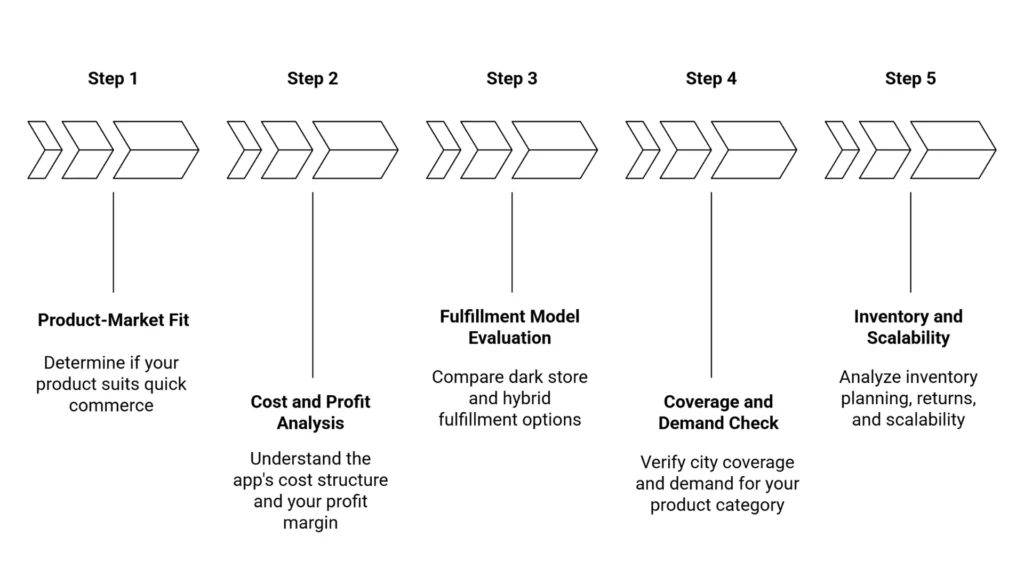
Quick commerce platforms can help sellers reach customers faster than ever. But choosing the wrong quick commerce company can lead sellers to high costs, stock losses, poor service quality, and unhappy customers. From a seller’s point of view, speed alone is not enough. The right platform should match your product type, margins, operations, and growth plans.
Here are the most important factors every seller must check before partnering with any quick commerce company in India.
1. Check If Your Product Truly Fits the Quick Commerce Model
Quick commerce works best for products that customers need urgently or frequently. From a seller’s point of view, the first step is to judge whether your product actually benefits from fast delivery. If customers don’t need your product immediately, quick commerce may increase costs without increasing sales.
Best-fit products usually have:
- Daily or repeat demand
- Urgent or impulse buying behaviour
- Short decision-making time
- Easy storage and quick picking
Products that may struggle:
- Low-margin or slow-moving items
- Bulky or fragile goods
- Products that need explanation or comparison
Speed only helps when customers value speed.
2. Understand the Cost Structure and Your Profit Margin
Quick commerce platforms in India charge more than traditional eCommerce portals because of fast delivery and local fulfillment hub (dark store). Sellers often make the mistake of onboarding first and calculating profits later. Always check whether your margins can absorb these costs.
You should clearly understand:
- Platform commission
- Dark store or fulfilment charges
- Packaging and handling fees
- Delivery or last-mile cost
- Marketing or visibility charges
High sales volume means nothing if profits are negative.
3. Evaluate the Fulfillment Model (Dark Store vs Hybrid)
Different quick commerce companies use different fulfilment models. Some fully control inventory through dark stores, while others use a hybrid model with kirana stores or local hubs. As a seller, this directly affects control, risk, and stock planning.
Things to check:
- Who owns and manages inventory?
- Who handles picking, packing, and storage?
- Who bears damage or expiry loss?
- How fast does stock replenishment happen?
Less control may give speed, but more risk.
4. Check City Coverage and Demand for Your Category
Quick commerce success is city and location-dependent. Even a big platform may not work well for your product if demand is low in specific cities or pincodes. Sellers should always check where the platform performs best.
Important questions to ask:
- In which cities is my category performing well?
- Is demand concentrated in metros or tier-2 cities?
- Are my products visible in high-order pincodes?
- Does the platform support future expansion areas?
Fast delivery matters only where enough customers exist.
5. Analyse Inventory Planning, Returns, and Scalability
Quick commerce needs tight inventory control. Poor stock planning leads to penalties, returns, and losses. Sellers must also think beyond the first few months and evaluate long-term scalability.
Check these carefully:
- Minimum stock requirement per location
- Stock ageing and expiry handling
- Return and damage responsibility
- Real-time inventory visibility
- Cost impact when order volume increases
A platform that works at low volume may break at scale.
Final Seller Advice
Choosing the right quick commerce company in India is not about joining the biggest name. It’s about choosing the platform that fits your product, margin, and operations. The right partner helps you grow profitably, not just sell faster.
Benefits of Selling Products Through Quick Commerce Companies

Selling products through quick commerce companies in India is like jumping onto a bullet train in the world of retail. It is all about speed, convenience, and customer satisfaction. Quick commerce platforms help businesses to reach a broader audience almost instantly, catering to consumers who crave on-demand delivery. Imagine having your products just a tap away for customers who don’t want to wait days for their orders. It’s a win-win for both sellers and buyers! Here are we mention a few benefits of selling on quick commerce platforms:
1. Increased Sales and Revenue
Quick commerce companies are growing exceptionally. They get demand for instant delivery, attracting more customers and increasing the frequency of purchases. These factors help businesses to get more sales and increased revenue.
2. Enhanced Customer Satisfaction and Loyalty
Consumers get their orders within minutes. It boosts customer satisfaction and builds long-term loyalty. Why? Because nothing delights a customer more than getting what they need, exactly when they need it.
3. Competitive Advantage
Selling through quick commerce companies in India gives your business a competitive edge in today’s fast-paced, growing ecommerce market. Imagine your brand being the go-to option for last-minute shoppers or busy individuals who value time over anything else—that’s the power of quick commerce. These quick commerce platforms also help you stay ahead by ensuring better visibility, particularly in crowded online marketplaces. Additionally, their advanced logistics and shipping networks allow you to scale without the burden of building your infrastructure.
4. Market Expansion
Quick commerce companies operate all across India, including Tier - 1,2, and 3 cities. Businesses have a great opportunity to get all India exposure for products. These platforms also provide insights into customer preferences and buying trends, helping you adapt your offerings for different markets. Plus, their ability to cater to diverse demographics means your brand gains exposure to a broader audience, boosting growth opportunities.
5. Reduced Storage Costs
Quick commerce companies can significantly reduce your warehouse storage costs, making them a game-changer for businesses looking to optimize expenses. These platforms often handle warehousing and inventory management, allowing you to save on renting or maintaining your own storage spaces. Think of it as outsourcing the hassle while keeping your business lean and efficient.
6. Improved Reliability and Sustainability
Quick commerce companies bring improved reliability and sustainability to your business operations. That creates a winning combination for modern markets. Their advanced logistics systems ensure consistent, on-time deliveries, building customer trust and strengthening your brand’s reputation. Reliability isn’t just about speed; it’s about fulfilling promises every time. On the sustainability front, many quick commerce platforms adopt eco-friendly practices like optimizing delivery routes and using electric vehicles. By associating with such companies, your business benefits from dependable service and aligns with the growing consumer demand for environmentally conscious practices.
Conclusion
Quick commerce companies in India capture the growing ecommerce market. Many big and small brands want to work with them to grow simultaneously. But the question is which one is the best fit for your product. Many e-commerce giants like Amazon and Meesho are stepping into the quick commerce space, signaling a significant shift in consumer demand and market trends. In this guide, we cover India's top 10 quick commerce companies that provide a vast market. As these big players enter the quick commerce race, the industry is set to evolve rapidly, reshaping how products are sold and delivered and ultimately raising the bar for customer convenience.