
Table of content:
- What Are E-Commerce Fulfillment Services In India?
- Why E-commerce Fulfillment Is Critical For Scaling Online Businesses In India?
- What Does a Reliable E-commerce Fulfillment Partner In India Do for Your Business?
- Key Benefits Of Using E-Commerce Fulfillment Services In India
- How E-commerce Fulfillment Services Work In India?
- Types of E-commerce Fulfillment Models Available In India
- What To Look for in an E-Commerce Fulfillment Company In India?
- Common Challenges in E-Commerce Fulfillment And How To Solve Them
- 3PL Ecommerce Fulfillment Vs. In-house Fulfillment
- Costs Of E-Commerce Fulfillment Services In India
- Final Words


India’s e-commerce market continues to scale rapidly. It is valued at USD 125 billion in 2024 and projected to reach USD 345 billion by 2030. This growth has pushed online brands to move faster, deliver accurately, and manage inventory across multiple channels without increasing operational complexity. As order volumes rise, logistics is no longer a back-end function. This directly shapes customer experience and repeat purchases across India.
This is where ecommerce fulfillment services in India play a critical role. Fulfillment partners in India manage the entire post-order journey, including warehousing, inventory tracking, picking, packing, and last-mile delivery. The process is backed by technology such as automation, real-time inventory systems, and data-driven workflows. These ecommerce fulfillment services help brands reduce fulfillment errors, shorten delivery timelines, and scale without investing heavily in infrastructure. This guide explains how fulfillment services work, when growing brands should outsource, and how to choose the right ecommerce fulfillment partner for long-term growth.
What Are E-Commerce Fulfillment Services In India?
Ecommerce fulfillment services are third-party logistics providers who manage storage, inventory, orders, delivery, and returns management for an e-commerce business. Today, many D2C brands, SMES, MSMES, and large e-commerce businesses partner with e-commerce fulfillment services in India. The partnership allows brands or e-commerce businesses to focus on core activities, such as product development or exploring new markets.
Why E-commerce Fulfillment Is Critical For Scaling Online Businesses In India?
Today, e-commerce fulfillment services are becoming increasingly important for online business owners for the following reasons.
- Today, customers expect their ordered products to reach them as soon as possible. Delay in product delivery can adversely affect brand reputation. When an e-commerce business manages storage and delivery altogether, it faces various challenges. Lack of modern technology can delay product delivery. Ecommerce fulfillment services in India use a TMS to select the most efficient route for delivering goods to their destination.
- When an e-commerce business enters the market, it can manage its storage and inventory properly. But as order volumes increase, it faces challenges in managing inventory and fulfilling orders. Manual order fulfillment processes can lead to overstocking and understocking of products. Understocking can lead to missed sales opportunities and dissatisfied customers. E-commerce fulfillment services in India use robotics, AI, machine learning, and advanced software to minimize errors and speed up order fulfillment.
What Does a Reliable E-commerce Fulfillment Partner In India Do for Your Business?
1. Order Processing and Last Mile Delivery
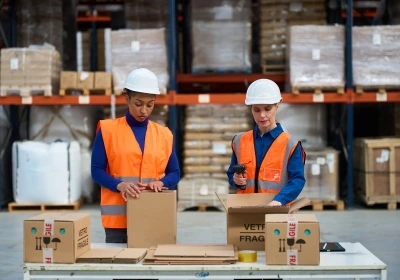
Ecommerce fulfillment services in India include order processing and last-mile delivery. The staff at the fulfillment center in India handles order picking, packaging, and shipping, as well as reverse logistics.
2. Inventory Storage and Real-Time Visibility
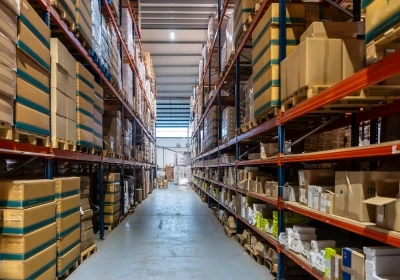
Ecommerce fulfillment centers provide secure storage solutions for a business. These fulfillment centers have CCTV surveillance and fire safety systems for almost 24 hours. Again, ecommerce fulfillment centers in India use technology such as a warehouse management system to track inventory in real time.
3. Returns and Reverse Logistics Management
Sometimes customers do not like the products they ordered and submit a return request. E-commerce fulfillment centers pick up products from customers and return them to the warehouse. A particular team inspects the product thoroughly and then decides whether to restock, refurbish, or recycle.
4. Tech Integration With Marketplaces
Modern e-commerce fulfillment center partners with online marketplaces like Flipkart and Amazon. This enables instant order syncing and automatic inventory updates in real time.
Key Benefits Of Using E-Commerce Fulfillment Services In India
There are various benefits of using e-commerce fulfillment services in India. The benefits are listed below.
1. Faster Order dispatch across India
E-commerce fulfillment centers in India have warehouses in various regions of India. Hence, they deliver products faster to the customers.
2. Lowers Operational & Logistics Costs
Building a warehouse for storage and managing staff, and buying equipment like forklifts, involves a lot of money, which is quite challenging for small and medium enterprises. E-commerce fulfillment companies in India have warehouses along with heavy equipment. These companies even provide shipping and logistics. Partnering with fulfillment companies in India reduces the business's operational costs.
3. Better Customer Experience
E-commerce fulfillment centers deliver products faster to customers. These centers even process returns faster and issue quick refunds to customers. This enhances customer satisfaction and improves the brand's market reputation.
4. Scalability During Sales and Festive Peaks
E-commerce fulfillment centers offer scalability, meaning they can accommodate more products as the business grows. The business can easily store more products during peak seasons in the e-commerce fulfillment center.
How E-commerce Fulfillment Services Work In India?
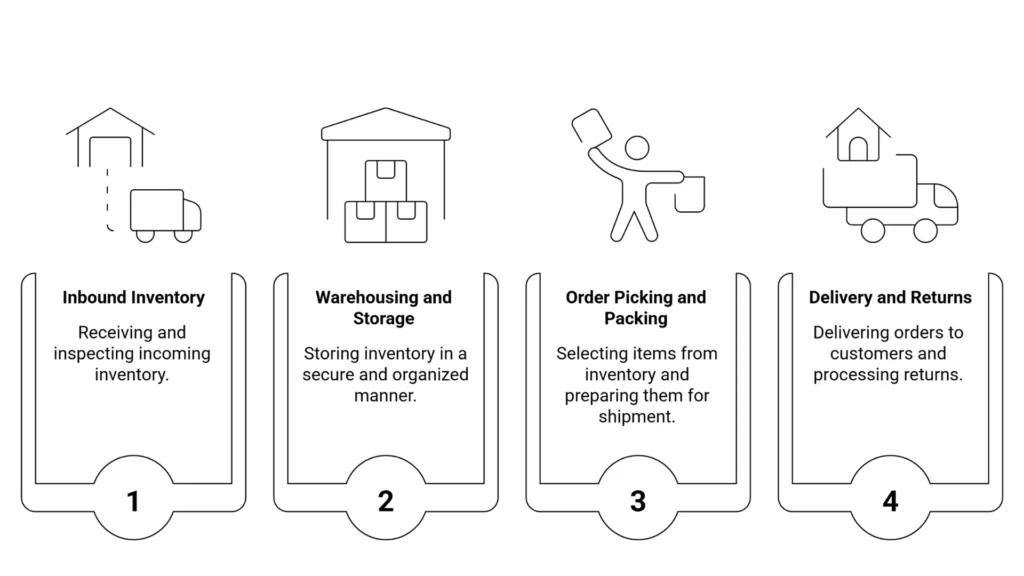
1. Inbound Inventory and Quality Checks
The business sends the goods or products to the e-commerce fulfillment center. The staff receive the goods, thoroughly inspect their quality, and enter them into the software.
2. Warehousing and Storage
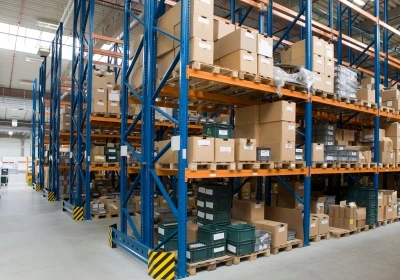
The staff stores the product on the racks or shelves based on their demand and size. Most e-commerce fulfillment centers use advanced technology to track inventory in real time.
3. Order Picking, Packing, Shipping
When a customer orders a product from the website, the order details are automatically sent to e-commerce fulfillment services in India. The staff picks up the ordered product, does the packaging, and hands it over to the shipper. The shipper finally delivers the ordered product to the customer.
4. Delivery, Returns, and Refund Processing
E-commerce fulfillment services provide last-mile services and enhance customer satisfaction.
Sometimes the customer doesn't like the ordered product and places a return request. The e-commerce fulfillment service picks up the product from the customer and brings it back to the warehouse. The fulfillment service even does quick refunds and enhances customer satisfaction.
Types of E-commerce Fulfillment Models Available In India
There are various types of e-commerce fulfillment models available in India.
- Marketplace Fulfillment: This model is mainly for sellers who sell on online marketplaces likeAmazon, Flipkart, and Meesho.
- D2C Fulfillment For Brand Websites: D2C fulfillment sells its products on its own website.
- Omnichannel Fulfillment: An omnichannel fulfillment model sells products through apps, websites, and physical stores.
What To Look for in an E-Commerce Fulfillment Company In India?
There are various ecommerce fulfillment companies in India. But it's challenging to find the right one. The business needs to consider several factors while choosing the right one.
- Warehouse Locations: An e-commerce fulfillment company in India should have warehouses in multiple cities to deliver products to customers faster.
- Technology Access: The e-commerce fulfillment center in India should leverage advanced technologies such as AI, machine learning, and a warehouse management system to optimize order fulfillment processes and enhance customer satisfaction.
- Scalability: It should be highly scalable, i.e., it should accommodate more products during peak seasons or holidays.
- Experience: The e-commerce fulfillment services in India should have enough years of experience and have positive testimonials and reviews.
Common Challenges in E-Commerce Fulfillment And How To Solve Them
E-commerce fulfillment services in India often face a few challenges. The challenges are listed below.
1. Inventory Mismatch
Sometimes the stocks are available online, but they are actually not available in the warehouse. Again, fast-moving products can suddenly go out of stock.
E-commerce fulfilment services in India should use low-stock alerts for fast-moving products. Again, the fulfillment center should use technology like barcode systems for tracking inventories.
2. High RTO and Returns
The e-commerce fulfillment service can have higher return rates due to the delivery of the wrong-sized products. The fulfillment service needs to analyse the return reasons and act accordingly. Simultaneously, the fulfillment service in India should improve product images and descriptions to reduce return rates.
3. Delivery Delays
The e-commerce fulfillment service can experience late delivery due to choosing the wrong route. It can dissatisfy customers and decrease brand reputation. The fulfillment center should use technology, such as a transport management system, to select the best, shortest route for product delivery.
3PL Ecommerce Fulfillment Vs. In-house Fulfillment
| Features | 3PL Fulfillment | Inhouse Fulfillment |
| Definition | The business outsources logistics, warehousing ,shipping and return management services to a 3PL fulfillment. | Here the business manages storage, logistics, warehousing and return management solely. |
| Delivery speed | 3PL fulfillment deliver products faster to the customers. | Product delivery in an Inhouse fulfillment depends on shipping courier partnerships and warehouse location. |
| Inventory tracking | It tracks inventories in real time by the usage of advanced software. | Inhouse fulfillment tracks inventories through manual processes which can lead to errors. It even causes problems of overstocking and understocking issues. |
| Scalability | It offers scalability features i.e it can accommodate more products during peak seasons or holidays. | Less scalable. The business will hire more staff and spend more money on infrastructure if it wants to accommodate more products during peak seasons. |
Costs Of E-Commerce Fulfillment Services In India
Key Cost Components
- Warehouse Costs (Costs associated with storing inventories)
- Inbound Receiving Charges (costs associated with receiving inventories from the seller)
- Picking & Packaging charges(Costs associated with picking ordered products and packaging)
- Shipping charges (charges based on order weight and location of delivery)
- Value-added services (charges for labelling, barcoding, kitting, and bundling)
- Return processing charges (charges for return pick up, restocking, or recycling)
Factors Affecting Fulfillment Pricing
- Bulky products increase shipping costs.
- Basic packaging does not charge more. But when a brand wants custom packaging, then the e-commerce fulfillment service can charge more.
- Faster dispatch or same-day shipping of products can cost more to the Business.
Final Words
There are various ecommerce fulfillment services in India. But choosing the right one can make a difference. In fact, a good e-commerce fulfillment center in India delivers products faster, reduces return rates, reduces storage costs, and enhances customer satisfaction with the business. It even allows a business to focus on core activities, such as product development and market expansion.