
Table of content:


India’s ecommerce market is growing rapidly, and behind every fast and accurate delivery is a well-managed warehouse. As order volumes increase, businesses face real challenges such as inventory mismatches, delayed dispatches, and inefficient space utilization. This is where warehouse management plays a critical role. It is not just about storing goods, but about managing the entire flow of operations from receiving and storage to picking, packing, and shipping in a structured and efficient way.
A well-managed warehouse directly impacts delivery speed, operational cost, and customer experience.
What is Warehouse Management
Warehouse management refers to the process of controlling and optimizing daily warehouse operations, from receiving goods to storing, picking, packing, and shipping orders efficiently. The goal is to ensure that the right products are available at the right time, in the right condition, and are dispatched without delays.
For example, in an ecommerce business, once an order is placed, the warehouse team must quickly locate the product, pick it accurately, pack it securely, and hand it over for delivery. Any delay or error at this stage can directly impact customer experience.
This is why warehouse management is not just about storage, but about maintaining speed, accuracy, and consistency across every stage of operations.
In modern supply chains, warehouse management is often supported by technology-driven systems to improve efficiency and reduce errors.
Warehouse Management Process
The warehouse management process is a sequence of interconnected steps that ensure smooth movement of goods from inbound to outbound. Each stage directly impacts speed, accuracy, and overall operational efficiency. Even a small delay or error in one step can affect the entire fulfillment cycle.
1. Receiving Goods
Receiving is the first and one of the most critical stages of warehouse operations. It involves unloading incoming goods and verifying them against purchase orders.
- What happens: Quantity and quality checks, inspection for damage, and system entry
- Common issues: Mismatch in quantity, damaged goods, incorrect documentation
- Optimization tip: Use barcode scanning and real-time entry to reduce manual errors
Why it matters: Errors at this stage carry forward into inventory and order fulfillment.
2. Putaway and Storage
Once verified, goods are placed in designated storage locations based on type, demand, and handling requirements.
- What happens: Items are assigned to bins, racks, or pallets
- Key concept: Warehouse slotting (placing fast-moving items in easily accessible locations)
- Common issues: Wrong placement, poor layout, wasted space
- Optimization tip: Use structured storage planning and vertical space efficiently
Impact: Poor putaway increases picking time and reduces efficiency.
3. Inventory Management and Tracking
This step ensures accurate visibility of stock levels and product locations within the warehouse.
- What happens: Inventory tracking using WMS, barcode scanners, or RFID
- Common issues: Stock discrepancies, overstocking, stockouts
- Optimization tip: Regular cycle counting and real-time inventory updates
Impact: Accurate inventory is essential for smooth order fulfillment.
4. Order Picking
Order picking is the process of retrieving items from storage to fulfill customer orders.
- What happens: Items are picked based on order details
- Picking methods: Batch picking, zone picking, wave picking
- Common issues: Picking errors, delays, inefficient routes
- Optimization tip: Optimize picking routes and use picking strategies based on order volume
Impact: Picking directly affects speed and accuracy of deliveries.
5. Packing and Shipping
Picked items are packed securely and prepared for dispatch.
- What happens: Packaging, labeling, and handover to shipping carriers
- Common issues: Wrong packaging, labeling errors, delays in dispatch
- Optimization tip: Standardize packaging processes and automate labeling
Key balance: Speed vs accuracy — both must be maintained.
6. Returns and Reverse Logistics
Return handling is a critical part of warehouse management, especially in ecommerce operations.
- What happens: Returned items are inspected, sorted, and restocked or discarded
- Common issues: Delayed processing, inventory mismatch, damaged returns
- Optimization tip: Define clear return workflows and inspection processes
Impact: Efficient returns management improves customer trust and inventory accuracy.
A small inefficiency in one stage can impact the entire supply chain.
Warehouse Management System (WMS)
What is a Warehouse Management System?
A Warehouse Management System (WMS) is software that helps businesses manage and optimize warehouse operations in real time. It tracks inventory movement, manages storage, and ensures accurate order fulfillment from the moment goods enter the warehouse until they are dispatched.
Instead of relying on manual processes, a WMS provides complete visibility and control over inventory, reducing errors and improving operational efficiency.
How a WMS Works
A WMS connects all warehouse activities into a single system and manages the flow of goods across different stages:
- Goods are scanned and recorded during receiving
- Items are assigned to optimized storage locations
- Inventory is tracked in real time across the warehouse
- Orders are processed with guided picking and packing
- Shipments are prepared and tracked for dispatch
This creates a connected and data-driven workflow, where every movement is tracked and optimized.
Key Features of a Warehouse Management System
- Real-Time Inventory Tracking: Tracks stock levels and product locations instantly using barcodes or RFID, reducing stock discrepancies.
- Barcode and RFID Integration: Automates data entry and improves accuracy during receiving, picking, and shipping.
- Order Management and Picking Optimization: Generates pick lists and suggests efficient picking routes to reduce time and errors.
- Warehouse Space Optimization: Recommends storage locations based on product demand, size, and movement.
- Reporting and Analytics: Provides insights into inventory, order accuracy, and warehouse performance for better decision-making.
Types of Warehouse Management Systems
- Standalone WMS: Focused only on warehouse operations, suitable for small to mid-sized businesses
- Cloud-Based WMS: Accessible from anywhere, ideal for multi-location warehouses
- Integrated WMS: Connected with ERP and other systems for end-to-end supply chain visibility
Why Businesses Use a WMS
- Improves inventory accuracy and reduces stock mismatches
- Speeds up order processing and fulfillment
- Optimizes warehouse space and labor usage
- Provides real-time visibility for better planning
Without a warehouse management system, scaling operations becomes nearly impossible as manual processes lead to errors, delays, and inventory mismatches.
Benefits, Challenges and Best Practices in Warehouse Management
Warehouse management directly impacts operational efficiency, cost control, and customer experience. However, managing a shared warehouse at scale also comes with several challenges. Businesses that adopt the right strategies and best practices can overcome these challenges and significantly improve performance.
Key Benefits of Effective Warehouse Management
A well-managed warehouse goes beyond storage and plays a critical role in overall business performance.
- Faster Order Fulfillment: Streamlined picking and packing processes reduce delivery time and improve customer satisfaction
- Improved Inventory Accuracy: Real-time tracking minimizes stock mismatches and prevents overstocking or stockouts
- Better Space Utilization: Optimized layout and storage strategies help maximize warehouse capacity
- Cost Reduction: Efficient operations reduce labor costs, errors, and unnecessary movement within the warehouse
Common Challenges in Warehouse Management
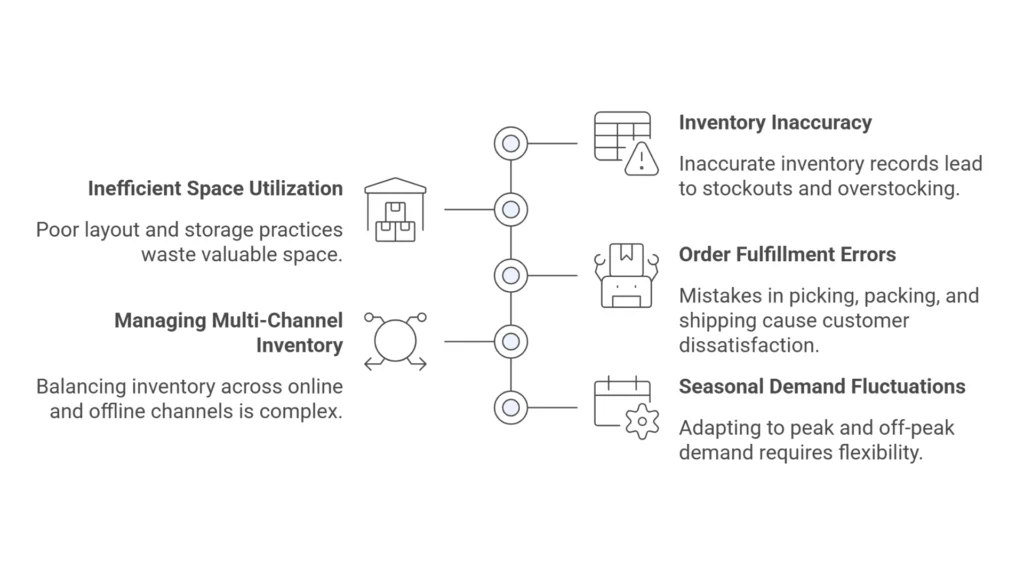
Despite its benefits, warehouse management comes with operational challenges that can affect performance if not handled properly.
1. Inventory Inaccuracy
- Mismatch between physical stock and system data
- Leads to stockouts, overstocking, and fulfillment errors
2. Inefficient Space Utilization
- Poor layout and storage planning
- Increases picking time and reduces productivity
3. Order Fulfillment Errors
- Mistakes in picking, packing, or labeling
- Directly impacts customer experience
4. Managing Multi-Channel Inventory
- Difficulty in syncing inventory across marketplaces and sales channels
5. Seasonal Demand Fluctuations
- Sudden spikes in orders during peak seasons
- Challenges in scaling operations quickly
Reality: Most warehouse inefficiencies come from poor visibility and lack of structured processes.
To address these challenges, businesses need to focus on structured processes and continuous improvement.
Best Practices to Improve Warehouse Management
To overcome these challenges, businesses must focus on structured processes, technology adoption, and continuous improvement.
- Use Technology for Real-Time Visibility: Implement a Warehouse Management System (WMS) with barcode or RFID tracking to reduce manual errors and improve accuracy.
- Optimize Warehouse Layout and Slotting: Place high-demand products in easily accessible locations and use vertical space effectively to reduce movement time.
- Standardize Picking and Packing Processes: Use defined picking methods such as batch or zone picking to improve speed and reduce errors.
- Conduct Regular Inventory Audits: Cycle counting and periodic checks help maintain accurate inventory records and prevent discrepancies.
- Train and Manage Workforce Efficiently: Ensure staff is well-trained and cross-skilled to handle different warehouse operations efficiently.
- Plan for Demand Fluctuations: Use data insights and forecasting to prepare for seasonal spikes and avoid operational bottlenecks.
A well-structured warehouse management strategy not only improves daily operations but also creates a strong foundation for scaling logistics and fulfillment as the business grows.
Warehouse Management in Ecommerce and 3PL
Warehouse management becomes more complex and critical in ecommerce and 3PL (third-party logistics) operations, where speed, accuracy, and scalability directly impact business performance.
In high-growth ecommerce businesses, inefficient warehouse management can quickly become a bottleneck, affecting delivery timelines and customer experience.
Handling Multi-Location Fulfillment
Ecommerce businesses often store inventory across multiple warehouses to enable faster deliveries across different regions.
- Orders are routed to the nearest warehouse
- Inventory must be synchronized across all locations
- Stock visibility needs to be updated in real time
Challenge: Without proper warehouse management, businesses can face stock mismatches and delayed order processing.
Managing High Order Volumes and Same-Day Delivery
With increasing customer expectations, businesses are under pressure to deliver orders quickly, often within the same day or next day.
- High volume of daily orders
- Faster picking, packing, and dispatch required
- Minimal room for errors
Impact: Even small inefficiencies in warehouse operations can lead to delivery delays and poor customer experience.
Inventory Synchronization Across Multiple Sales Channels
Ecommerce businesses sell across multiple platforms such as marketplaces, websites, and offline channels.
- Inventory must be updated across all channels in real time
- Overselling or stockouts can occur without proper synchronization
Solution: Centralized warehouse management systems help maintain accurate inventory visibility across all platforms.
Role of 3PL in Warehouse Management
3PL providers manage warehousing and fulfillment operations for multiple clients, making efficiency and scalability even more important.
- Shared warehouse infrastructure
- Handling multiple brands and SKUs
- Managing bulk and small orders simultaneously
Advantage: Businesses can scale faster without investing in their own warehouse infrastructure.
For growing ecommerce businesses, managing warehouse operations internally can become complex and resource-intensive. This is where partnering with an experienced 3PL provider helps streamline operations and improve fulfillment efficiency.
Warehouse Management vs Inventory Management
Warehouse management and inventory management are closely related but serve different purposes within supply chain operations.
| Aspect | Warehouse Management | Inventory Management |
| Focus | Physical movement of goods inside the warehouse | Tracking stock levels and availability |
| Scope | Storage, picking, packing, shipping | Stock control, demand planning |
| Objective | Efficient warehouse operations | Maintaining optimal inventory levels |
| Tools | WMS (Warehouse Management System) | Inventory management software |
Key Difference
Warehouse management focuses on how goods move within the warehouse, while inventory management focuses on how much stock is available and when to replenish it.
How They Work Together
Both functions are interconnected. Efficient warehouse management ensures smooth operations, while inventory management ensures the right products are available to fulfill orders.
Effective warehouse management plays a key role in improving operational efficiency, reducing costs, and delivering a better customer experience.