
Table of content:
- Why Does Business Need Warehouse Storage Facilities In Delhi?
- Type Of Warehouse Storage Facilities Available In Delhi
- Cost Of Warehouse Storage Facility In Delhi: What Businesses Should Expect
- Delhi VS NCR For Warehouse Storage
- Key Locations For Warehouse Storage In Delhi NCR
- What Business Should Evaluate Before Choosing A Warehouse In Delhi?
- Common Mistakes While Selecting Warehouse Storage In Delhi
- Who Should Use a Warehouse Storage Facility In Delhi?
- Final Words
- Frequently Asked Questions – Warehouse Storage in Delhi


Delhi serves as the major logistics and distribution hub in India. It connects well with nearby cities like Gurugram, Noida, and Ghaziabad, enabling faster delivery to customers in those areas. Again, the Indira Gandhi International Airport in Delhi facilitates easy air cargo movement. Hence, businesses consider a warehouse storage facility in Delhi. But one of the major challenges is the high land and rental costs in Delhi. Industrial land is limited and costly, thereby increasing warehouse storage costs in Delhi.
Why Does Business Need Warehouse Storage Facilities In Delhi?
1. Manufacturing And Trading Concentration
Delhi and the surrounding NCR are home to various industries, as follows.
- Automobile And Auto Components: There are various automobile companies in Faridabad and Gurugram, and they require proper storage facilities for storing components. Hence, most automobile companies have partnerships with warehouse storage facilities in Delhi.
- Consumer Electronics And Appliances: Various electronics industries require secure storage facilities for their components. Hence, most electronics companies partner with commercial warehouse space in Delhi.
- Textiles and Apparel: Numerous textile and apparel industries depend on reliable storage before distributing their products to customers.
- Pharmaceuticals And FMCG: Pharmaceutical companies need properly temperature-controlled facilities to store drugs and vaccines and maintain their shelf life. Hence, most pharmaceutical companies partner with a warehouse storage facility in Delhi.
2. Proximity To NCR Markets
Delhi is closer to the NCR, which includes Gurugram, Noida, Faridabad, and Ghaziabad. Today, many industries in NCR depend on a warehouse storage facility in Delhi as it can deliver products faster, i.e., either on the same or next day to customers and enhance brand reputation in the market.
3. Access to Highways, Rail, ICDs & Ports Via NCR
Major National highways such as NH-44, NH-48, and the Yamuna Expressway run through Delhi and enable seamless goods movement to various regions of India. Again, multiple rail lines enable efficient cargo movement.
Delhi is not near the sea. But its excellent road and railway lines connect to major ports like Mundra and Kandla, facilitating the easy import and export of goods.
Type Of Warehouse Storage Facilities Available In Delhi
1. Commercial Warehouse Storage
This warehouse facility in Delhi primarily stores electronics, garments, and FMCG goods. Traders, wholesalers, and distributors can use this warehousing in Delhi to quickly distribute goods in Delhi and the NCR.
2. Industrial And Manufacturing Warehouses
This commercial warehouse in Delhi primarily stores heavy goods, raw materials, and machinery. These warehouses have large floor areas and high ceilings. Businesses can store automobile components, manufacturing units, and engineered goods in these warehouses.
3. 3PL & Managed Warehousing
3PL warehouses provide complete logistics support to the business. These warehouses not only store products but also pick ordered products, package them, and hand them over to the shipper. The shipper finally delivers the product to the customer. In short, 3PL warehouses handle the entire order fulfillment and logistics, allowing business owners to focus on core activities like product development and market exploration.
4. Cold Storage and Temperature-Controlled Warehouses
These warehouses maintain controlled temperature conditions for sensitive goods. These warehouses primarily store pharmaceuticals, food & beverages, and dairy products.
5. Bonded Warehouses
Bonded warehouses store imported goods without paying customs duty immediately. These warehouses are mainly for importers and International trading Companies.
Cost Of Warehouse Storage Facility In Delhi: What Businesses Should Expect
What Affects Warehouse Storage Cost In Delhi?
1. Location
Warehouses located near central areas of Delhi charge more than those in the NCR outskirts, such as Gurugram and Ghaziabad.
2. Warehouse Type
Standard commercial warehouse storage costs less than cold storage and temperature-controlled facilities.
3. Infrastructure & Compliance
The modern warehouse storage facility in Delhi complies with fire safety regulations and provides 24/7 CCTV surveillance. They even use advanced technologies such as WMS and an inventory management system. These warehouses will cost more compared to basic godowns.
4. Storage Model
Today, modern warehouse storage facilities in Delhi have fire safety compliance, dock-level loading, and 24/7 security. These types of storage facilities in Delhi will cost you more compared to basic godowns.
Why Delhi City Warehouses Cost More But Scale Poorly?
The warehouses in core Delhi face a few limitations, as follows.
- High land and rental costs
- Limited space to expand
- Modern warehouses in Delhi do not have a dock-level loading area. They do not even have a low ceiling height. It limits scalability and makes order fulfillment operations less efficient than those in modern warehouse parks.
- Delhi has heavy traffic congestion, which adversely affects operational efficiency and slows down logistics movement.
Why Are NCR Locations More Cost-Effective?
- Land prices in NCR are lower than in core Delhi. So, businesses can get a larger warehouse in the NCR region to store products at a lower cost. The warehouses are even easily scalable, i.e., they can accommodate.
- NCR areas have grade A warehouses with high ceiling heights and dock-level loading areas. A business can get better warehouse infrastructure at lower costs in NCR.
Delhi VS NCR For Warehouse Storage
| Aspect | Delhi | NCR |
| Cost structure | High rental cost per square foot. | Low rental costs. |
| Expansion flexibility | Limited land availability.So warehouses struggle to expand in Delhi. | Easy expansion of warehouses. |
| Suitable | Delhi warehouses are mainly for businesses who require small storage requirements. | NCR warehouses are mainly for businesses which require large space requirements. |
| Truck Restrictions | Heavy vehicle entry restrictions | Easy truck entry and proximity to highways. |
Key Locations For Warehouse Storage In Delhi NCR
- North Delhi Belt: Businesses should choose the Bawana and Narela industrial areas in the North Delhi belt, as they have good road connectivity.
- West Delhi Industrial Zones: Businesses should choose the Mayapuri or Kirti Nagar industrial area because of their good access to central markets.
- South Delhi: South Delhi has limited warehouse space due to urban development and high real estate prices.
- NCR Extensions: Today, many businesses prefer the outskirts of NCR, like Sonipat and Kundi, for storing products. These regions have Grade A warehouses that offer businesses low storage costs. They also have better highway connectivity and are easily scalable.
What Business Should Evaluate Before Choosing A Warehouse In Delhi?
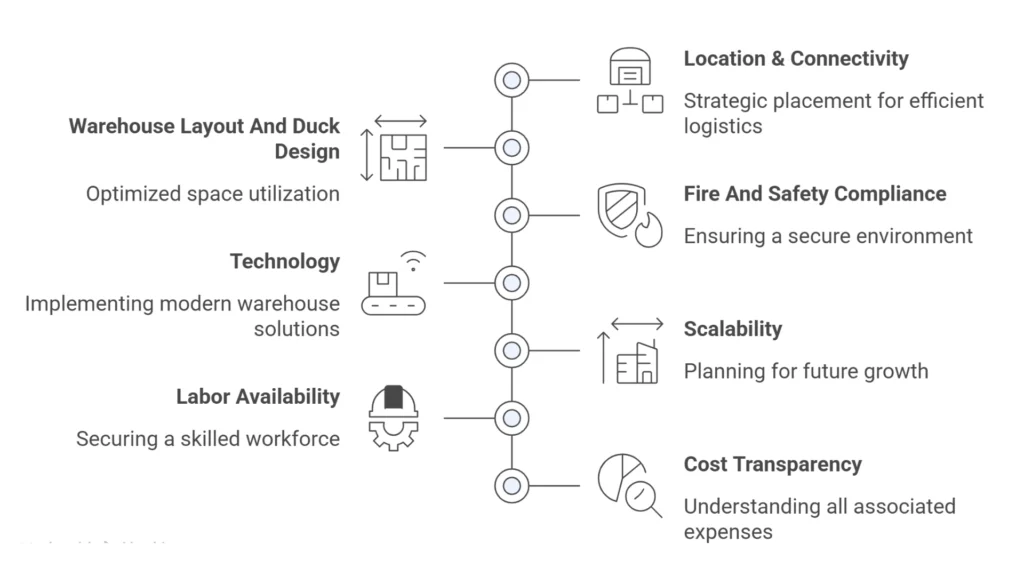
Businesses should consider several factors when choosing a warehouse storage facility in Delhi. They are in the list below.
1. Location & Connectivity
The business should choose a warehouse well-connected to the National Highways and expressways. It should also be closer to target markets. It will reduce shipping costs and deliver products to customers faster.
2. Warehouse Layout And Duck Design
A business should choose a storage warehouse in Delhi NCR with a good layout, i.e., clear height, column spacing, and dock-level loading, to enhance operational efficiency.
3. Fire And Safety Compliance
Businesses need to ensure that the warehouse storage facility in Delhi is insured and provides 24-hour CCTV security. Non-compliant warehouses can create legal risks in the future.
4. Technology
A business should choose a warehouse storage facility in Delhi that uses advanced technologies such as WMS, barcodes, and RFID for order fulfillment. It reduces errors and avoids overstocking and understocking.
5. Scalability
A business should choose a storage warehouse in Delhi NCR that offers scalable solutions, i.e., one that can accommodate more products during peak seasons and holidays.
6. Labour Availability
The warehouse storage facility in Delhi should have skilled manpower to fulfill orders.
7. Cost Transparency
The storage warehouse in Delhi NCR should provide a complete, transparent cost structure. There should be no hidden charges for extra product handling.
Common Mistakes While Selecting Warehouse Storage In Delhi
1. Choose Cheap Godowns Inside City Limits
Many businesses choose cheap godowns or warehouses for storing products. But this indicates that the warehouse does not use advanced technology to fulfill orders or manage inventory. It can lead to overstocking and understocking.
2. Ignoring Truck Movement Restrictions
One of the biggest mistakes while selecting a storage facility in Delhi is ignoring the truck movement restrictions. Delhi has limited hours for truck entry. Heavy vehicles, such as trucks, have to wait longer, causing delays in product delivery.
3. No Tech Visibility
If a business chooses a warehouse that does not use advanced technology, then it causes delays in order delivery. It even creates problems of overstocking and understocking.
4. Not Planning For Volume Growth
Some businesses choose a warehouse based on current order volumes. The warehouse cannot accommodate products when market demand increases during a particular season.
5. Ignoring Reporting And Inventory Visibility
If a business ignores structured reporting, it cannot properly track stock movement.
Who Should Use a Warehouse Storage Facility In Delhi?
- B2B businesses
- D2C and an ecommerce brand
- Manufacturers
- Importers and International traders
A commercial warehouse storage facility in Delhi is not suitable for holding personal or household goods.
Final Words
Warehouse storage facility in Delhi uses advanced software for fulfilling order fulfillment operations of a business. They provide fire safety compliance and CCTV surveillance for almost 24 hours. But there are various warehouses in Delhi. Businesses need to consider several factors, such as their location, access to technology, cost structure, and reviews, before entering into a partnership.