
Table of content:
- What Is Stock Replenishment?
- Replenishment Vs Reordering Vs Forecasting
- What Really Determines When Inventory Should Be Replenished?
- Different Types Of Stock Replenishment Methods
- Stock Replenishment Formula
- How do businesses choose the right replenishment approach for their inventory?
- Common Stock Replenishment That Creates Overstock And Stockouts
- Final Words


Stock replenishment isn't just about refilling inventory. It's about making the right decision at the right time, for the right product. Businesses struggle not because they don't reorder stock, but because they rely on formulas or automation that don't reflect real demand, supplier variability, or SKU behavior.
Let's understand what stock replenishment actually means, how replenishment methods and formulas work, and where automation helps (and where it fails). Also, explore how businesses can choose an approach that aligns with their inventory complexity. Whether you manage a single warehouse or multiple locations, this article will help you move from reactive restocking to controlled, confident replenishment planning.
What Is Stock Replenishment?
Stock replenishment is a process of restocking products inside the warehouse to maintain optimal levels and enhance customer satisfaction. The business needs to analyse sales data and demand patterns properly, then determine the optimal quantity to reorder to avoid stockouts and overstocking.
Stock replenishment is one of the most important steps of the order fulfilment process. When a warehouse has the optimal inventory level, staff can immediately pick ordered products, package them, and ship them to the customer.
Let's discuss with an example.
A supermarket sells 40 packets of milk per day. The lead time from the supplier is 3 days, and the safety stock is 50 packets.
So stock replenishments = (Daily sales * Lead time) + Safety stock
Stock replenishment = (40 * 3) + 50 = 170 packets
So the supermarket needs to replenish milk packets when the stock drops to 170.
Replenishment Vs Reordering Vs Forecasting
| Aspect | Replenishment | Reordering | Forecasting |
| Definition | Overall process of restocking products in the warehouse. | The act of placing new order | Predicting product demand in market in near future. |
| Decision | The business takes decision based upon current stock, product demand and lead time. | The business reorders product when the stock decreases upto a certain point. | The business predicts product demand in advance. |
What Really Determines When Inventory Should Be Replenished?
Many businesses rely on simple reorder points to replenish products. But in reality, the business needs to consider four factors for inventory replenishment.
1. Lead Time Variability
Lead time variability refers to the inconsistency in the time it takes for stock to arrive in the warehouse after an order is placed. It can happen due to shortages of raw materials, product delays, or traffic congestion.
If lead times are more unpredictable, the business should replenish products as early as possible.
2. Demand Volatility
Product demand can suddenly rise due to promotions, marketing campaigns, or competitors' stockouts. Volatile demand requires frequent stock replenishment.
3. Supplier Behaviour
Supplier behaviour even plays an important role in stock replenishment. If the suppliers are unreliable, then businesses need to replenish products earlier.
4. Seasonality
Product demand can increase during specific seasons, holidays, or weather conditions. Let's discuss with an example: if a shopkeeper sells winter clothes and demand is high in December, then it should replenish stock in November.
Different Types Of Stock Replenishment Methods
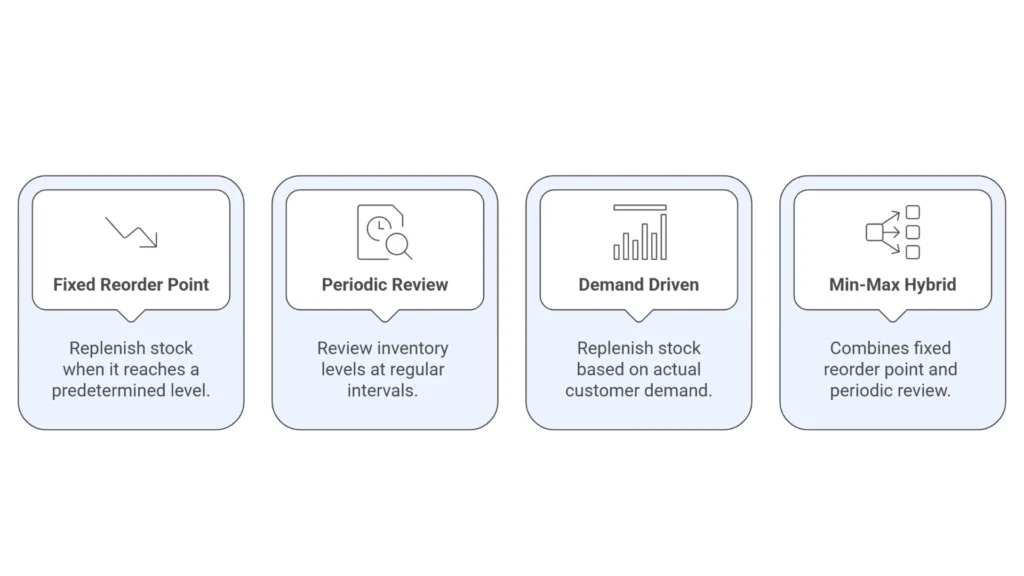
There are various methods of stock replenishment. They are in the list below.
1. Fixed Reorder Point Method
The business replenishes inventory when the stock falls to a predefined level or reorder point. The replenishment order is triggered automatically or manually when the warehouse inventory drops to a specified level. The business can calculate the reorder point based on three factors: average demand, lead time, and safety stock. This method will work best for businesses with predictable lead times.
2. Periodic Review Methods
Here, the warehouse staff checks inventory levels within a few weeks or months, then decides on stock replenishment. It goes well for businesses that manage numerous types of stock in the 3PL warehouse. But problems can arise when a stock-out occurs between review periods.
3. Demand Driven Replenishment Models
These models adjust inventory decisions based on real-time customer demand rather than fixed reorder points.
4. Min-Max Hybrid Approaches
This method defines a minimum and maximum stock level. The business replenishes stock when the level drops to the minimum.
Hybrid approaches combine multiple methods, such as fixed reorder point and periodic review methods.
Stock Replenishment Formula
The most common stock replenishment trigger is the reorder point.
Reorder point = (Average demand * Lead time ) + Safety stock
Average demand - Demand of the product on a particular day.
Lead time - Time taken to restock product.
Safety stock - Buffer in the warehouse to meet uncertainty.
The formulas assume that sellers are reliable and product demand is stable in the market. The lead time is also fixed.
But in reality, the demand volatility can increase suddenly. The supplier may delay delivery of products to the warehouse. So the business should adjust the formula accordingly.
How do businesses choose the right replenishment approach for their inventory?
1. Fast-moving SKUs
Fast-moving SKUs have consistent market demand. Businesses should either set a fixed reorder point or use a demand-driven replenishment method for this type of inventory.
2. Slow Movers
These items do not sell frequently in the market. Hence, businesses should use periodic review methods for these types of inventories.
3. Multilocation Stock
These items are spread across the business's various warehouses, distribution centers, and retail stores. Replenishment is complex here because demand, lead time, and stock availability vary from one location to another. Most users centralize planning using location-specific rules, then decide when and where to replenish.
4. Seasonal Demand
Seasonal demand occurs when product demand suddenly increases in a particular festival or season. Businesses need to rely on historical and sales data to replenish seasonal items in advance.
Common Stock Replenishment That Creates Overstock And Stockouts
- If a business overrelies on historical averages for stock replenishment, it can lead to overstocking and understocking.
- If a business uses manual systems for tracking inventory in the warehouse, it can lead to errors and cause overstocking or understocking.
- If a business assumes suppliers will deliver products on time, it is one of the primary reasons for warehouse stock issues.
Final Words
Stock replenishment is no longer limited to restocking shelves and racks in the warehouse. The business needs to make informed decisions regarding when and how much to reorder inventory to avoid stock issues. A successful business owner should depend only on formulas. It needs to consider other factors, such as demand variability and lead time fluctuations, when replenishing stock.